Posted in Hands-on activities, Learning styles, Math, Sensory, Student engagement, Tactile

Chapter 74: Jellybean Ratios

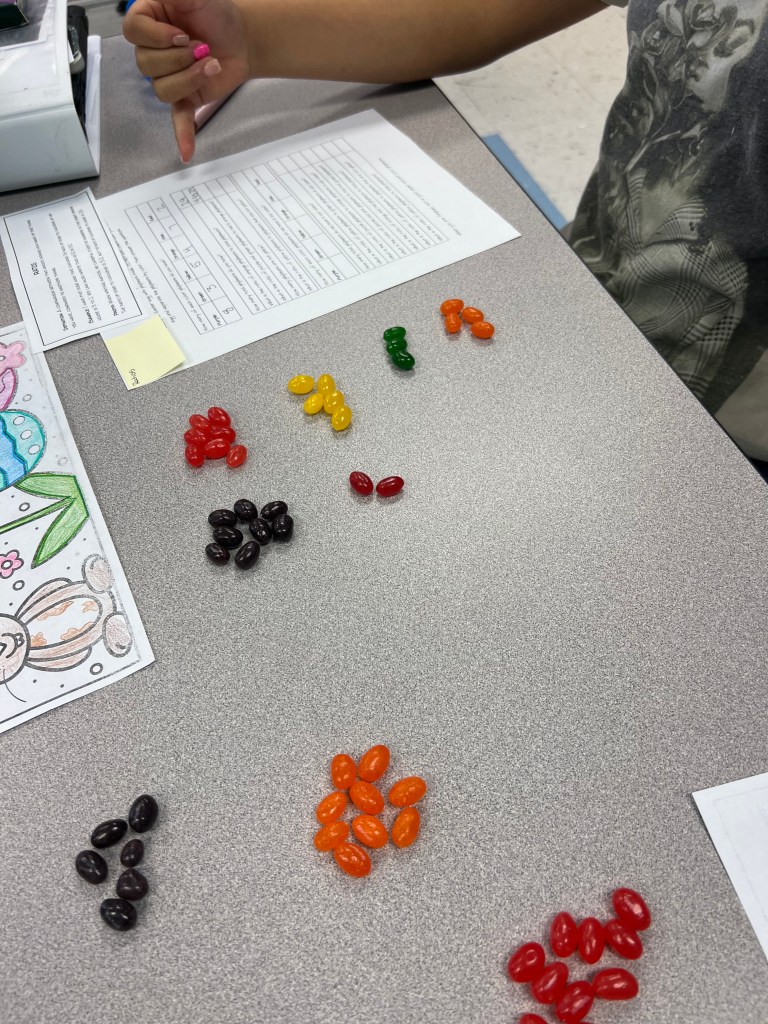
Some of my students are starting a unit on ratios, so I gave them a sweet lesson: I brought in plastic Easter eggs full of jellybeans and instructed them to sort the jellybeans by color, complete a table showing the number of each color they had, and then answer a series of questions:

  • How many total jellybeans do you have?
  • What is the ratio of orange jellybeans to total jellybeans?
  • What is the ratio of purple and green jellybeans to red and orange jellybeans?
  • How many jellybeans are not yellow?
  • What is the ratio of yellow jellybeans to jellybeans that are not yellow?
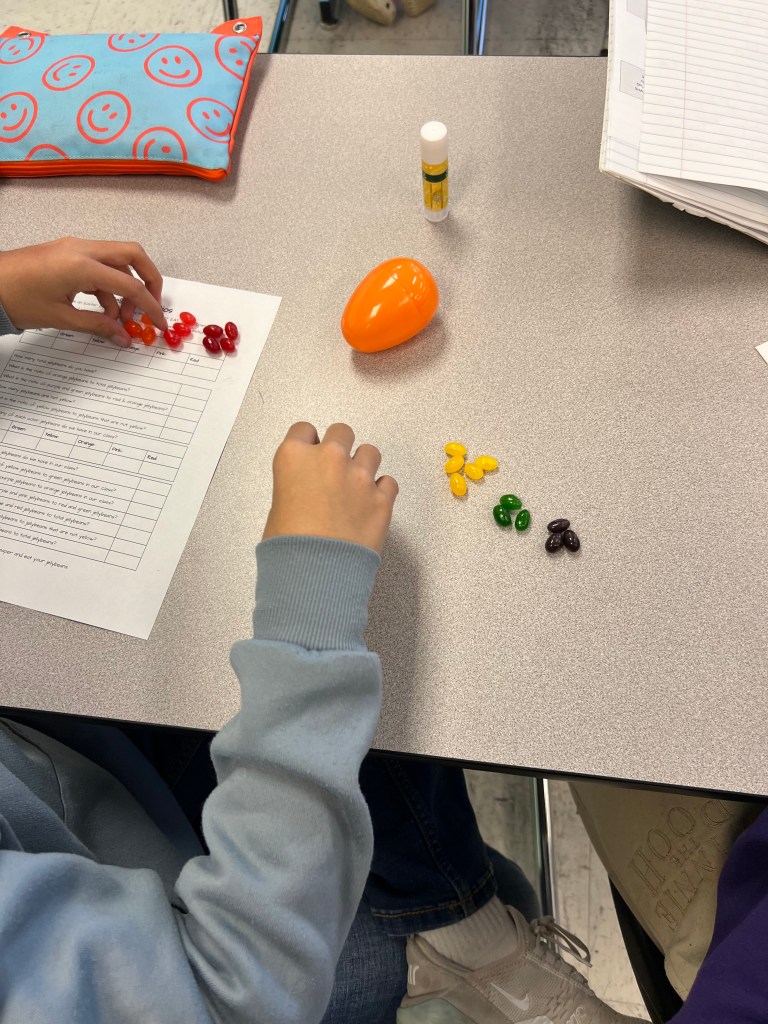
Once they had their individual jellybeans sorted, I helped them get their class totals, which they entered into a new table, and then they used those numbers to solve a second series of problems:

  • How many total jellybeans do we have in our class?
  • What is the ratio of yellow jellybeans to green jellybeans in our class?
  • What is the ratio of purple jellybeans to orange jellybeans in our class?
  • What is the ratio of purple and pink jellybeans to red and green jellybeans?
  • What is the ratio of orange and red jellybeans to total jellybeans?
  • What is the ratio of yellow jellybeans to jellybeans that are not yellow?
  • What is the ratio of yellow jellybeans to total jellybeans?

Once they completed the assignment, we checked our answers, and then they were allowed to eat their jellybeans.

You can use any type of candy for this activity, as long as it comes in multiple colors and isn’t too messy. I’ve used M&Ms, Starbursts, Skittles, and jellybeans with equal success. Fruit-flavored Tootsie Rolls and Laffy Taffy would also work. I chose jellybeans this time around because A.) I have a student with an allergy that renders M&Ms unsafe, and B.) jellybeans are cheap right now because it’s almost Easter.

Every time I’ve done this activity, I’ve gotten 100% engagement. There’s nothing like the prospect of free candy to get kids invested in a lesson. It’s a very Montessori sort of activity, too, because it involves multiple senses: The kids are looking at the candy, reading and listening to the instructions, discussing their answers, handling the candy as they sort it by color, and (their favorite) tasting and smelling the candy when they get to eat it at the end of the lesson.
Posted in Differentiated instruction, Hands-on activities, Kinesthetic, Learning styles, Math, Student engagement

Chapter 71: Batter Up!

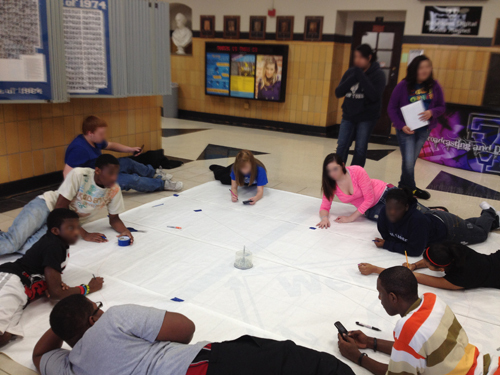
My seventh-graders did another baseball-themed lesson today. This one was really fun: We went to the gym and took batting practice with a wiffle ball and bat. The rules were a variant on the coach-pitch munchkin league softball my little sister played in the late ’80s and early ’90s: I gave every batter seven pitches, and each pitch had three possible outcomes — strike, foul, or hit. Any contact that wasn’t foul was recorded as a hit, and any pitch that didn’t result in contact was recorded as a strike, regardless of how good or bad a pitch it was.

Each student took a turn batting while the rest of the class recorded the outcome of each pitch on a chart that included columns for the batter’s name, each of the seven pitches, the batter’s total hits, and the batter’s contact rate. After we got through the lineup, we returned to class and got out our calculators. The kids counted the hits for each batter, then divided the hits by seven (the total number of pitches) to get a makeshift batting average. Once they had calculated all of the numbers for all of the batters, they used them to calculate the class average.

This was one of those days when I ended up with 100% engagement, and the kids were spectacularly cooperative: silent in the hall on the way to and from the gym, efficient when they reached the gym — no dawdling or horsing around between batters, and I had a couple of ballplayers chasing down balls for me so I wouldn’t have any long delays between pitches — and completely invested in the math when we returned to my classroom. I was especially pleased when I noticed several of the kids helping their classmates by filling in their stats when they were batting. This was completely voluntary — they just started doing it on their own — and wound up being a great timesaver because the batters didn’t have to stop and copy down their own stats after each at-bat.

I love it when my instincts are right, and a lesson that sounds great on paper lives up to its potential.

Posted in Hands-on activities, Math, Student engagement

Chapter 70: Sabermetrics

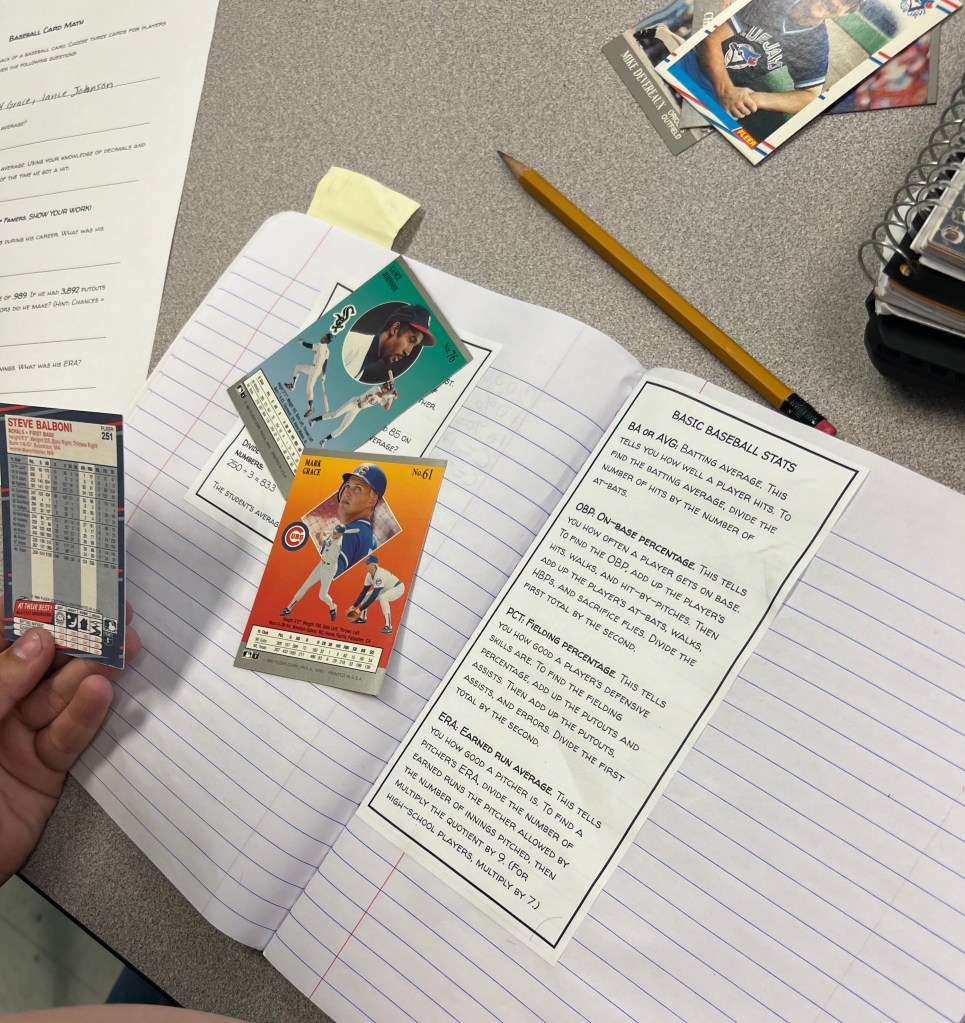
It had been YEARS since I had an excuse to break out a pack of baseball cards in class, but this week, we had a rudimentary lesson on sabermetrics (the study of baseball statistics) to reinforce what my seventh-graders have been learning about ratios, percentages, and averages.

For the first lesson, I did a quick overview of three relatively simple stats: batting average, fielding percentage, and ERA. Each of these stats is pretty easy to understand and to calculate.

I made a cheat sheet with the definition and formula for each stat, plus OBP (which we didn’t end up using for this lesson but might play with later), and had the kids paste it into their notebooks so they’d have everything they needed to work with the numbers.

I used to have a pretty respectable baseball card collection, but I gave it to my softball-obsessed goddaughter and her older sister about 10 years ago, when I didn’t think I’d be teaching math again, so my first order of business was to scrounge up some cards. I found a bundle of seven old ’80s and ’90s wax packs on Amazon for $11.50 and let the first group of students have the fun of opening the packs to see what was inside (with a careful admonition not to chew any gum they found inside, as it was likely to be older than their parents).

I put the kids in groups of two or three and gave each group a wax pack and a handout containing the following text:

Baseball Card Math

There’s a lot of math on the back of a baseball card. Choose three cards for players who are not pitchers and answer the following questions:

1. Who are your three players?
2. Which player has the best batting average?
3. Choose one player. Look at his batting average. Using your knowledge of decimals and percentages, determine what percentage of the time he got a hit.
Now, let’s look at some of my favorite Hall of Famers. SHOW YOUR WORK!
4. Ted Williams had 2,654 hits in 7,706 at-bats during his career. What was his lifetime batting average?
5. Ryne Sandberg has a lifetime fielding percentage of .989. If he had 3,892 putouts and 6,648 assists in 10,660 chances, how many errors did he make? (Hint: Chances = putouts + assists + errors.)
6. Mariano Rivera allowed 315 earned runs in 1,283.2 innings. What was his ERA?

Question 2 seemed easy enough, but I quickly realized that most of the kids had no idea how to find information on the back of a baseball card, so we had to do a quick mini-lesson on that. (Fleer’s weird habit of using “PCT” to mean batting average instead of fielding percentage didn’t help.) Question 3 tied into our recent study of percentages, while Question 4 helped build their confidence. Question 5 was a bit of red herring, because the kids’ cheat sheets contained the formula for calculating fielding percentage, but the question itself really only required them to find the difference between Sandberg’s chances and his successful plays. The math is easy, but they had to slow down and think about the question, which is challenging for them. Meanwhile, Question 6 was easy for the kids who referred to their notes, but those who tried to work from memory got it wrong because they forgot to multiply the ratio of ER to IP by 9 to get the answer.

Assuming the kids cooperate, tomorrow’s lesson — which is based on one I did about 12 years ago in Tulsa — should be even more fun. If it goes smoothly, I’ll share it.

Posted in Hands-on activities, Instructional design, Kinesthetic, Learning styles, Math, Student engagement

Chapter 63: The Force Is Strong With These

My eighth-graders used a lightsaber to help them remember the difference between positive and negative integers. I threw some simple addition and subtraction problems on the board and had them take turns walking along the number line, pointing with the lightsaber, as they counted off numbers to solve the problems. Everything to the left of zero was the Dark Side, and everything to the right was the Light Side. The Star Wars analogy was silly, but they had fun with it, and it helped them remember the difference.

If you teach math, and you don’t already have one, I highly recommend making a number line that the kids can see from across the room and posting it on the wall above your whiteboard. Physically walking along the number line really helps the kids get their heads around integers.

Posted in Cross-curricular instruction, ELA, Hands-on activities, Journalism, Lesson plans, Newspaper, Project-based learning, Teachable moments

Chapter 54: A Three-Week-Long Teachable Moment

One of the best things about being a journalism teacher is that virtually anything that happens can be a teachable moment.

Case in point: Here in New Mexico, Gov. Michelle Lujan Grisham announced yesterday evening that all public schools in the state would close for three weeks, beginning Monday, to contain the potential spread of coronavirus. That means some of my kids will lose some instructional time. But for the kids in my journalism class, this is an opportunity to practice what they’ve been learning in class in the most real-world setting imaginable. History is unfolding around them, and they’re covering it.

Last night, within 30 minutes of the governor’s announcement, several of my student journalists and I were on our phones, holding a meeting via text message to start planning our coverage of the school closure and its effects on our district. Several kids started doing online research to learn more about the virus and why the governor would close school for it. Others started brainstorming story ideas and coming up with lists of questions and sources they could chase down via phone or email to get information. My husband, who works for the local weekly newspaper, gave us a press release from the governor’s office that contained a link to the press conference she’d scheduled for this morning; several kids made the effort to get online and try to watch it this morning. (I’m not sure how many succeeded, because we all encountered some tech issues, but that’s OK — glitches are part of life in a newsroom, too.) Continue reading “Chapter 54: A Three-Week-Long Teachable Moment”