Posted in Hands-on activities, Learning styles, Math, Sensory, Student engagement, Tactile

Chapter 74: Jellybean Ratios

Some of my students are starting a unit on ratios, so I gave them a sweet lesson: I brought in plastic Easter eggs full of jellybeans and instructed them to sort the jellybeans by color, complete a table showing the number of each color they had, and then answer a series of questions:

  • How many total jellybeans do you have?
  • What is the ratio of orange jellybeans to total jellybeans?
  • What is the ratio of purple and green jellybeans to red and orange jellybeans?
  • How many jellybeans are not yellow?
  • What is the ratio of yellow jellybeans to jellybeans that are not yellow?
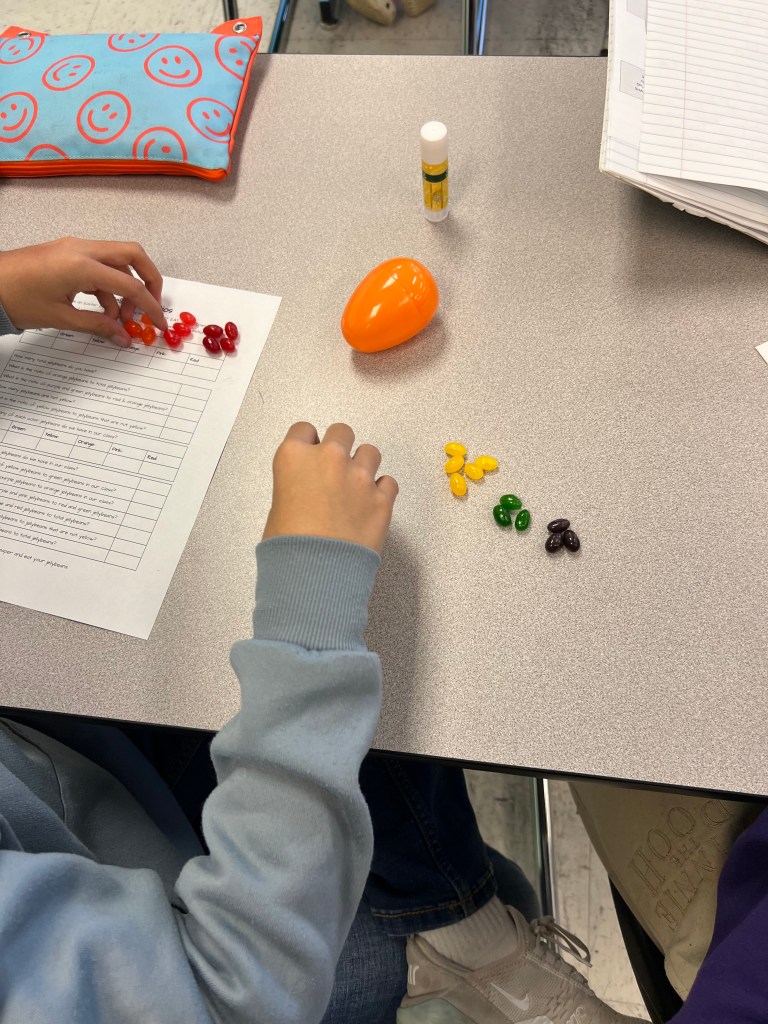
Once they had their individual jellybeans sorted, I helped them get their class totals, which they entered into a new table, and then they used those numbers to solve a second series of problems:

  • How many total jellybeans do we have in our class?
  • What is the ratio of yellow jellybeans to green jellybeans in our class?
  • What is the ratio of purple jellybeans to orange jellybeans in our class?
  • What is the ratio of purple and pink jellybeans to red and green jellybeans?
  • What is the ratio of orange and red jellybeans to total jellybeans?
  • What is the ratio of yellow jellybeans to jellybeans that are not yellow?
  • What is the ratio of yellow jellybeans to total jellybeans?

Once they completed the assignment, we checked our answers, and then they were allowed to eat their jellybeans.

You can use any type of candy for this activity, as long as it comes in multiple colors and isn’t too messy. I’ve used M&Ms, Starbursts, Skittles, and jellybeans with equal success. Fruit-flavored Tootsie Rolls and Laffy Taffy would also work. I chose jellybeans this time around because A.) I have a student with an allergy that renders M&Ms unsafe, and B.) jellybeans are cheap right now because it’s almost Easter.

Every time I’ve done this activity, I’ve gotten 100% engagement. There’s nothing like the prospect of free candy to get kids invested in a lesson. It’s a very Montessori sort of activity, too, because it involves multiple senses: The kids are looking at the candy, reading and listening to the instructions, discussing their answers, handling the candy as they sort it by color, and (their favorite) tasting and smelling the candy when they get to eat it at the end of the lesson.

Posted in Differentiated instruction, Hands-on activities, Kinesthetic, Learning styles, Math, Student engagement

Chapter 71: Batter Up!

My seventh-graders did another baseball-themed lesson today. This one was really fun: We went to the gym and took batting practice with a wiffle ball and bat. The rules were a variant on the coach-pitch munchkin league softball my little sister played in the late ’80s and early ’90s: I gave every batter seven pitches, and each pitch had three possible outcomes — strike, foul, or hit. Any contact that wasn’t foul was recorded as a hit, and any pitch that didn’t result in contact was recorded as a strike, regardless of how good or bad a pitch it was.

Each student took a turn batting while the rest of the class recorded the outcome of each pitch on a chart that included columns for the batter’s name, each of the seven pitches, the batter’s total hits, and the batter’s contact rate. After we got through the lineup, we returned to class and got out our calculators. The kids counted the hits for each batter, then divided the hits by seven (the total number of pitches) to get a makeshift batting average. Once they had calculated all of the numbers for all of the batters, they used them to calculate the class average.

This was one of those days when I ended up with 100% engagement, and the kids were spectacularly cooperative: silent in the hall on the way to and from the gym, efficient when they reached the gym — no dawdling or horsing around between batters, and I had a couple of ballplayers chasing down balls for me so I wouldn’t have any long delays between pitches — and completely invested in the math when we returned to my classroom. I was especially pleased when I noticed several of the kids helping their classmates by filling in their stats when they were batting. This was completely voluntary — they just started doing it on their own — and wound up being a great timesaver because the batters didn’t have to stop and copy down their own stats after each at-bat.

I love it when my instincts are right, and a lesson that sounds great on paper lives up to its potential.

Posted in Collaborative learning, Competition, Differentiated instruction, Games, Instructional design, Kinesthetic, Learning styles, Math, Student engagement, Test prep

Chapter 66: On Target

I have a love-hate relationship with school breaks. On the one hand, they’re a chance to decompress, catch up on some projects at home, do some advance planning, and spend some time with my dogs. On the other hand, they’re a monumental disruption that distracts the kids and makes it extremely difficult to get them to concentrate on anything long enough to learn.

This ain’t my first rodeo, so I got wise this year and didn’t bother attempting to teach anything new the week before spring break. Instead, I devoted the entire week to activities meant to reinforce concepts the kids had already mastered: a catch-up day on Monday to help my frequent absentees backfill those last few holes in the gradebook ahead of report cards; a doodle-by-numbers activity I pulled off Teachers Pay Teachers to review angle-sum rules; an Easter-egg hunt with math problems inside the eggs and a key that required the kids to find the correct answers in order to get their next clue; and a low-prep darts game we’ve played a time or two in the past.

The game is very simple. Get yourself a ball-darts game and a bunch of math problems over whatever the kids have been learning recently. I bought the dartboard you see in the picture from Amazon earlier this year. The kids like it because the board and the balls all light up.

Divide the class into two teams (if you have an odd number of kids, choose one to be your scorekeeper) and have them form two lines. The first kid on Team 1 throws a ball at the dartboard to determine the point value for the first question. Kid 1 can confer with the rest of the team about the answer to the question, but Kid 1 is the only person allowed to answer it. If Team 1 misses, Team 2 has a chance to rebound before throwing the ball and answering a question of their own.

I like this game a lot because it’s high-engagement; gives struggling learners a chance to practice with help from their classmates; meets the kids’ social needs; and requires no prep beyond downloading a worksheet and printing it out to use as your question bank. (Protip: If you need a bunch of questions quickly, search Teachers Pay Teachers for your concept + “drill” to find practice problem sets.)

If you want to send your engagement through the roof, keep a supply of dollar-store prizes on hand and award a small prize to the winning team. (For my middle-schoolers, I’ve found candy and anything dinosaur-themed to be popular prizes, but your mileage may vary.)

Posted in Hands-on activities, Instructional design, Kinesthetic, Learning styles, Math, Student engagement

Chapter 63: The Force Is Strong With These

My eighth-graders used a lightsaber to help them remember the difference between positive and negative integers. I threw some simple addition and subtraction problems on the board and had them take turns walking along the number line, pointing with the lightsaber, as they counted off numbers to solve the problems. Everything to the left of zero was the Dark Side, and everything to the right was the Light Side. The Star Wars analogy was silly, but they had fun with it, and it helped them remember the difference.

If you teach math, and you don’t already have one, I highly recommend making a number line that the kids can see from across the room and posting it on the wall above your whiteboard. Physically walking along the number line really helps the kids get their heads around integers.

Posted in Kinesthetic, Learning styles, Math, STEM, Tactile

Chapter 36: Positive or negative?

When I taught math in Tulsa, one concept my freshmen really struggled to understand was the difference between positive and negative integers. They simply could not get their heads around the idea that -5 was not the same thing as 5, and I despaired of ever making them understand it.

We added and subtracted. We graphed inequalities on number lines made from yardsticks and chalkboard paint. I constructed a walkable number line and had them wander back and forth to solve problems. We wrangled with those integers every day, in every way I could dream up, to no avail: Some kids caught on, but some still would get to the end of a lesson and say, “Isn’t minus three the same thing as three?” until I was ready to pull my hair out.

I decided the lesson would be more memorable if they were emotionally invested in it, so I brought in a bag of Starbursts and started handing them out, a few at a time, with instructions to wait until the end of class to eat them.

Continue reading “Chapter 36: Positive or negative?”