Posted in Hands-on activities, Learning styles, Math, Sensory, Student engagement, Tactile

Chapter 74: Jellybean Ratios

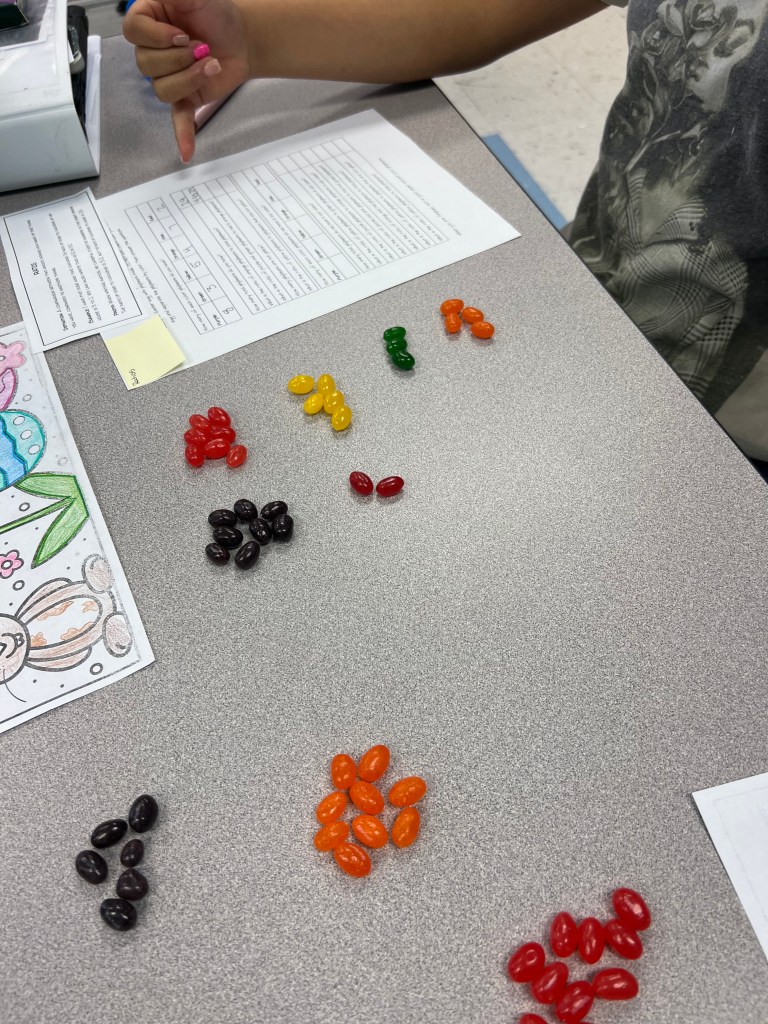
Some of my students are starting a unit on ratios, so I gave them a sweet lesson: I brought in plastic Easter eggs full of jellybeans and instructed them to sort the jellybeans by color, complete a table showing the number of each color they had, and then answer a series of questions:

  • How many total jellybeans do you have?
  • What is the ratio of orange jellybeans to total jellybeans?
  • What is the ratio of purple and green jellybeans to red and orange jellybeans?
  • How many jellybeans are not yellow?
  • What is the ratio of yellow jellybeans to jellybeans that are not yellow?
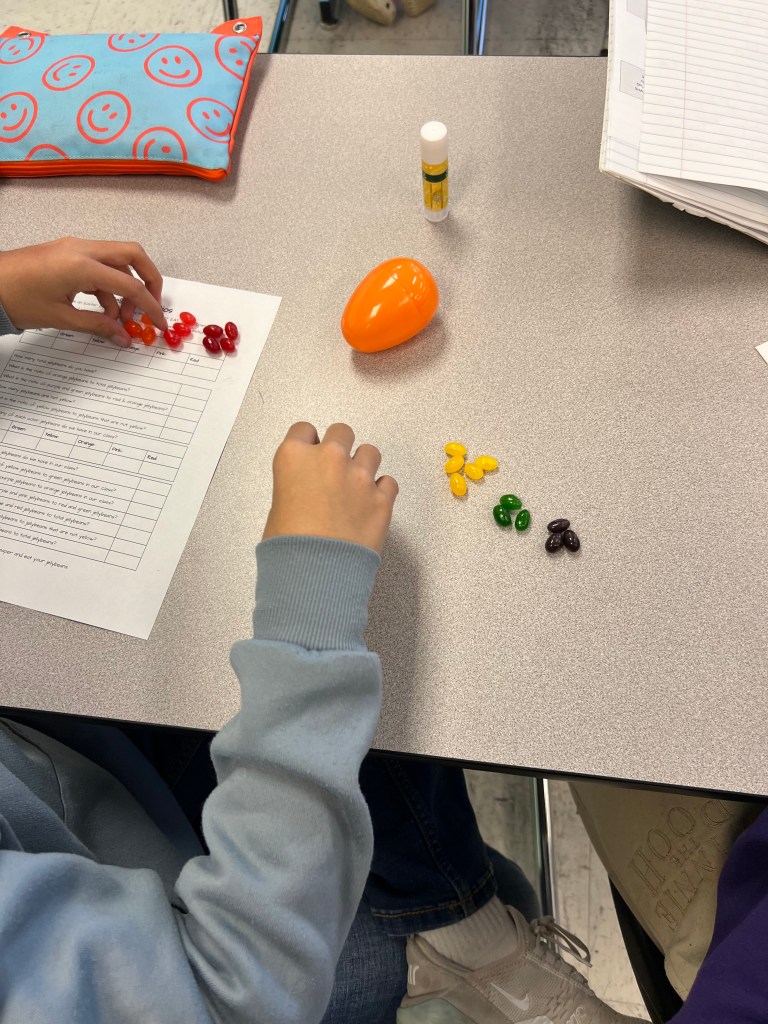
Once they had their individual jellybeans sorted, I helped them get their class totals, which they entered into a new table, and then they used those numbers to solve a second series of problems:

  • How many total jellybeans do we have in our class?
  • What is the ratio of yellow jellybeans to green jellybeans in our class?
  • What is the ratio of purple jellybeans to orange jellybeans in our class?
  • What is the ratio of purple and pink jellybeans to red and green jellybeans?
  • What is the ratio of orange and red jellybeans to total jellybeans?
  • What is the ratio of yellow jellybeans to jellybeans that are not yellow?
  • What is the ratio of yellow jellybeans to total jellybeans?

Once they completed the assignment, we checked our answers, and then they were allowed to eat their jellybeans.

You can use any type of candy for this activity, as long as it comes in multiple colors and isn’t too messy. I’ve used M&Ms, Starbursts, Skittles, and jellybeans with equal success. Fruit-flavored Tootsie Rolls and Laffy Taffy would also work. I chose jellybeans this time around because A.) I have a student with an allergy that renders M&Ms unsafe, and B.) jellybeans are cheap right now because it’s almost Easter.

Every time I’ve done this activity, I’ve gotten 100% engagement. There’s nothing like the prospect of free candy to get kids invested in a lesson. It’s a very Montessori sort of activity, too, because it involves multiple senses: The kids are looking at the candy, reading and listening to the instructions, discussing their answers, handling the candy as they sort it by color, and (their favorite) tasting and smelling the candy when they get to eat it at the end of the lesson.
Posted in Differentiated instruction, Hands-on activities, Kinesthetic, Learning styles, Math, Student engagement

Chapter 71: Batter Up!

My seventh-graders did another baseball-themed lesson today. This one was really fun: We went to the gym and took batting practice with a wiffle ball and bat. The rules were a variant on the coach-pitch munchkin league softball my little sister played in the late ’80s and early ’90s: I gave every batter seven pitches, and each pitch had three possible outcomes — strike, foul, or hit. Any contact that wasn’t foul was recorded as a hit, and any pitch that didn’t result in contact was recorded as a strike, regardless of how good or bad a pitch it was.

Each student took a turn batting while the rest of the class recorded the outcome of each pitch on a chart that included columns for the batter’s name, each of the seven pitches, the batter’s total hits, and the batter’s contact rate. After we got through the lineup, we returned to class and got out our calculators. The kids counted the hits for each batter, then divided the hits by seven (the total number of pitches) to get a makeshift batting average. Once they had calculated all of the numbers for all of the batters, they used them to calculate the class average.

This was one of those days when I ended up with 100% engagement, and the kids were spectacularly cooperative: silent in the hall on the way to and from the gym, efficient when they reached the gym — no dawdling or horsing around between batters, and I had a couple of ballplayers chasing down balls for me so I wouldn’t have any long delays between pitches — and completely invested in the math when we returned to my classroom. I was especially pleased when I noticed several of the kids helping their classmates by filling in their stats when they were batting. This was completely voluntary — they just started doing it on their own — and wound up being a great timesaver because the batters didn’t have to stop and copy down their own stats after each at-bat.

I love it when my instincts are right, and a lesson that sounds great on paper lives up to its potential.

Posted in Hands-on activities, Math, Student engagement

Chapter 70: Sabermetrics

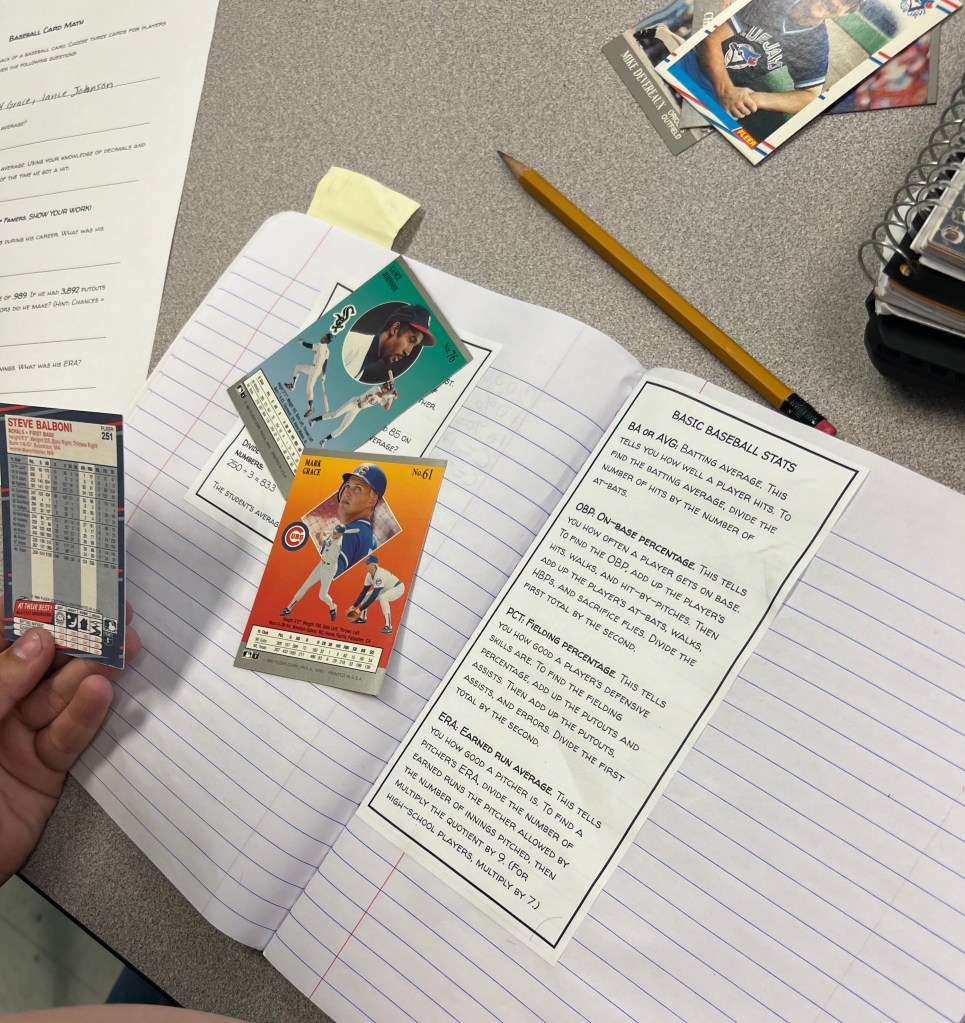
It had been YEARS since I had an excuse to break out a pack of baseball cards in class, but this week, we had a rudimentary lesson on sabermetrics (the study of baseball statistics) to reinforce what my seventh-graders have been learning about ratios, percentages, and averages.

For the first lesson, I did a quick overview of three relatively simple stats: batting average, fielding percentage, and ERA. Each of these stats is pretty easy to understand and to calculate.

I made a cheat sheet with the definition and formula for each stat, plus OBP (which we didn’t end up using for this lesson but might play with later), and had the kids paste it into their notebooks so they’d have everything they needed to work with the numbers.

I used to have a pretty respectable baseball card collection, but I gave it to my softball-obsessed goddaughter and her older sister about 10 years ago, when I didn’t think I’d be teaching math again, so my first order of business was to scrounge up some cards. I found a bundle of seven old ’80s and ’90s wax packs on Amazon for $11.50 and let the first group of students have the fun of opening the packs to see what was inside (with a careful admonition not to chew any gum they found inside, as it was likely to be older than their parents).

I put the kids in groups of two or three and gave each group a wax pack and a handout containing the following text:

Baseball Card Math

There’s a lot of math on the back of a baseball card. Choose three cards for players who are not pitchers and answer the following questions:

1. Who are your three players?
2. Which player has the best batting average?
3. Choose one player. Look at his batting average. Using your knowledge of decimals and percentages, determine what percentage of the time he got a hit.
Now, let’s look at some of my favorite Hall of Famers. SHOW YOUR WORK!
4. Ted Williams had 2,654 hits in 7,706 at-bats during his career. What was his lifetime batting average?
5. Ryne Sandberg has a lifetime fielding percentage of .989. If he had 3,892 putouts and 6,648 assists in 10,660 chances, how many errors did he make? (Hint: Chances = putouts + assists + errors.)
6. Mariano Rivera allowed 315 earned runs in 1,283.2 innings. What was his ERA?

Question 2 seemed easy enough, but I quickly realized that most of the kids had no idea how to find information on the back of a baseball card, so we had to do a quick mini-lesson on that. (Fleer’s weird habit of using “PCT” to mean batting average instead of fielding percentage didn’t help.) Question 3 tied into our recent study of percentages, while Question 4 helped build their confidence. Question 5 was a bit of red herring, because the kids’ cheat sheets contained the formula for calculating fielding percentage, but the question itself really only required them to find the difference between Sandberg’s chances and his successful plays. The math is easy, but they had to slow down and think about the question, which is challenging for them. Meanwhile, Question 6 was easy for the kids who referred to their notes, but those who tried to work from memory got it wrong because they forgot to multiply the ratio of ER to IP by 9 to get the answer.

Assuming the kids cooperate, tomorrow’s lesson — which is based on one I did about 12 years ago in Tulsa — should be even more fun. If it goes smoothly, I’ll share it.

Posted in Collaborative learning, Competition, Math, Student engagement, Success

Chapter 68: Road Trip!

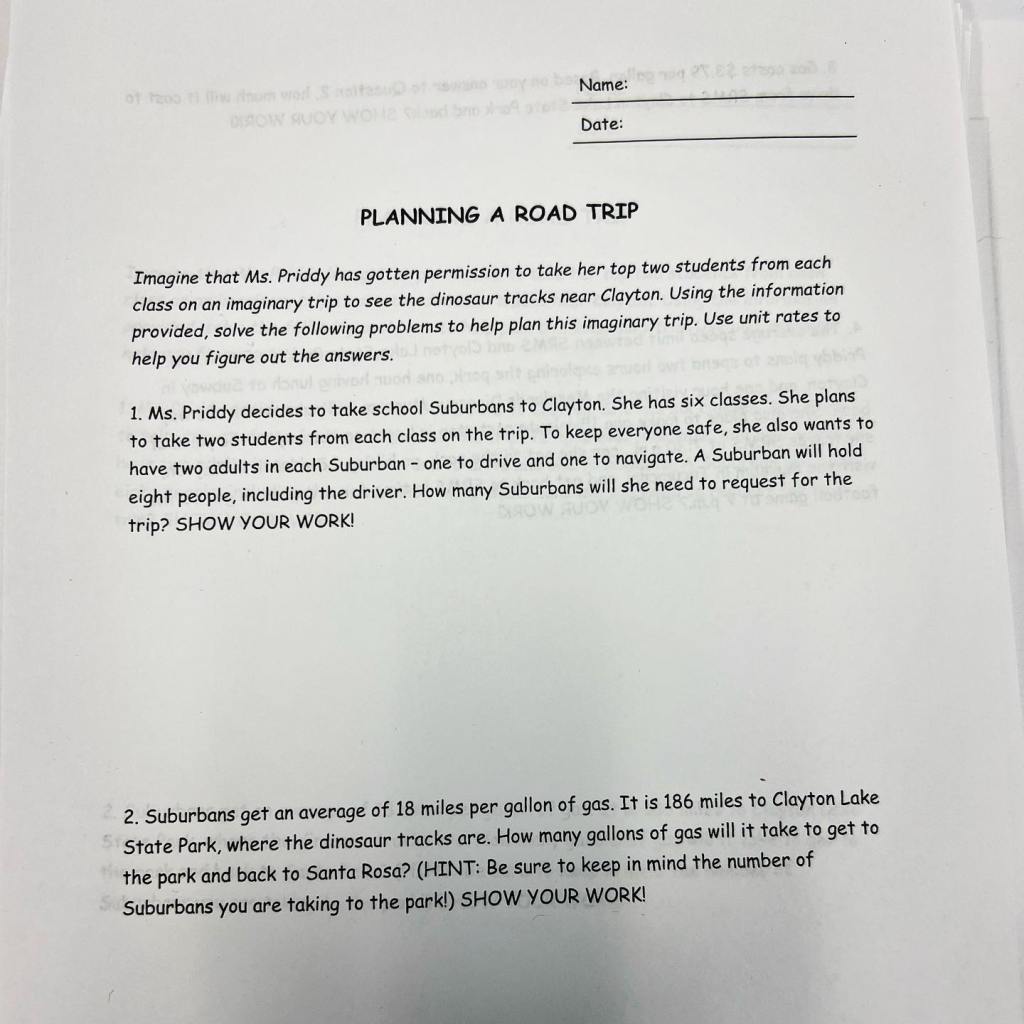
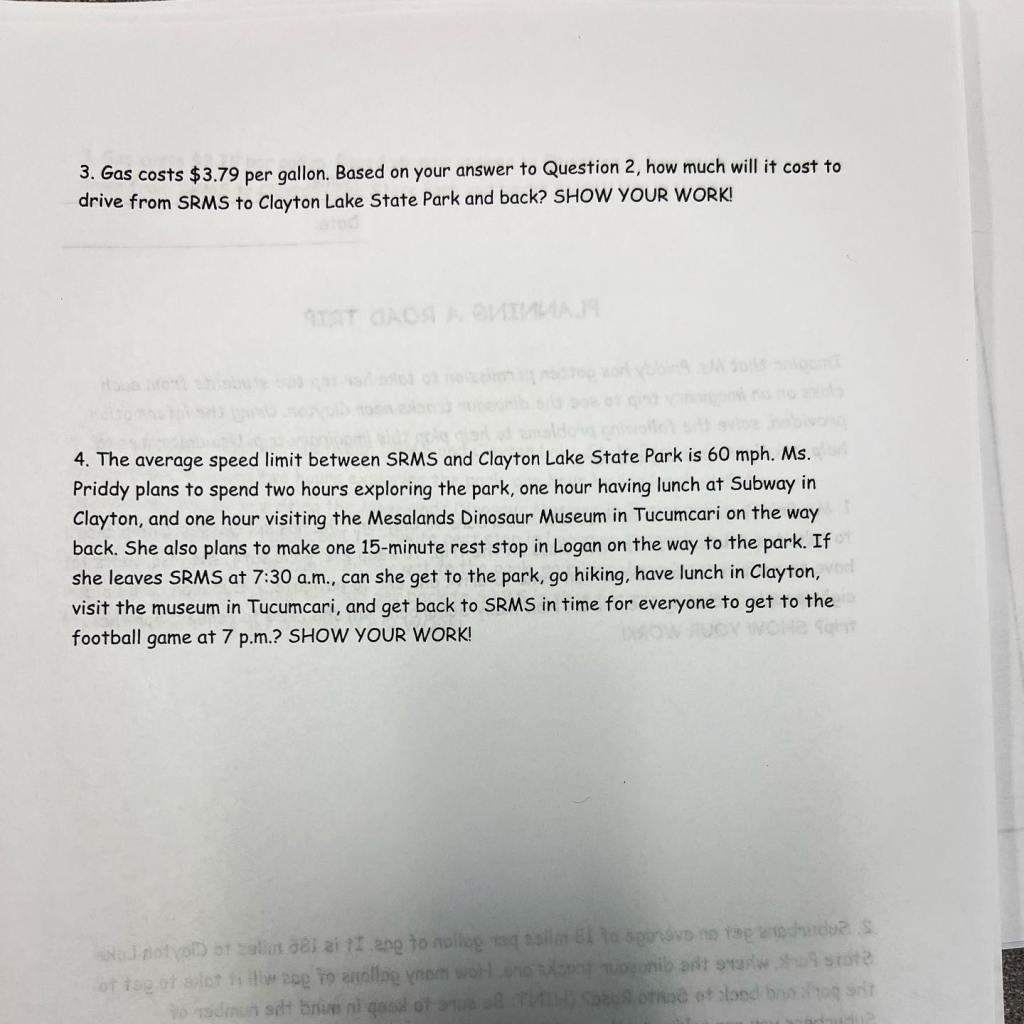
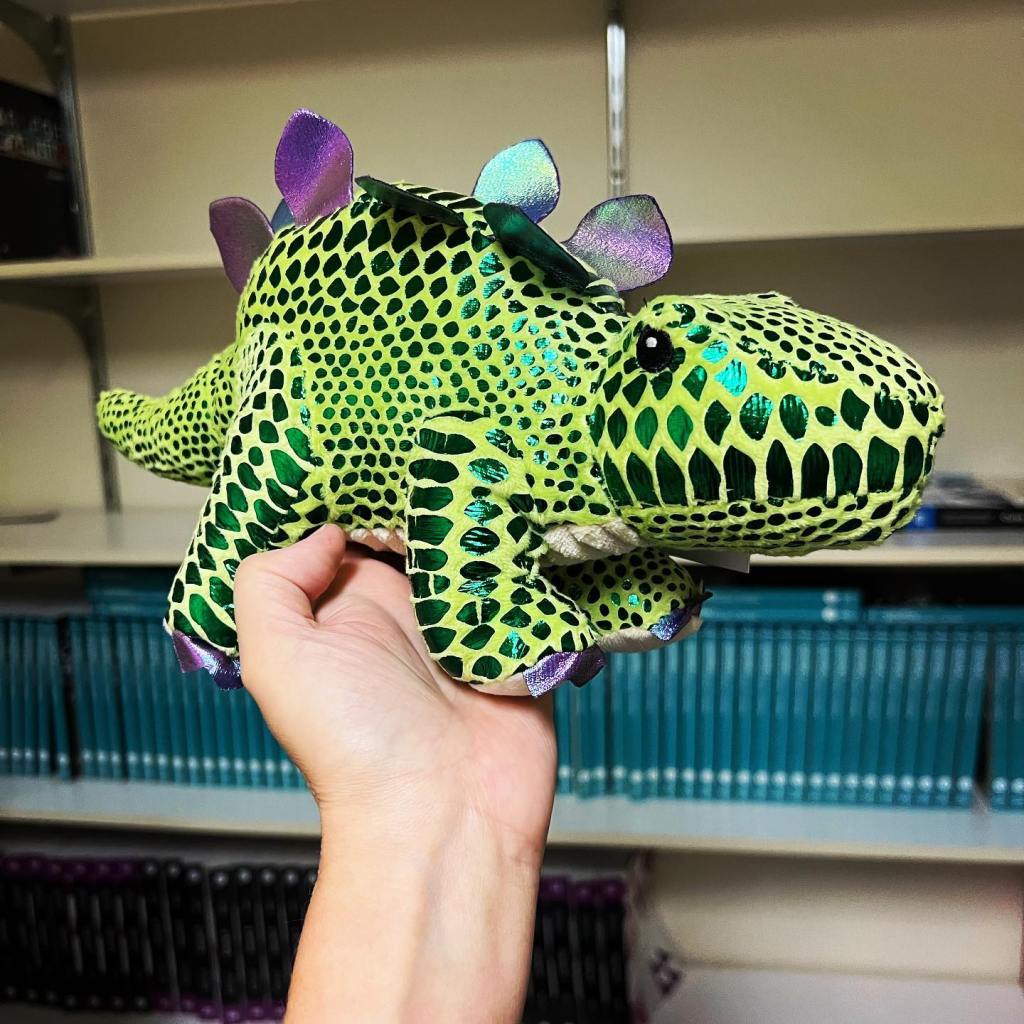
Kids sometimes have trouble understanding why they need to learn math, especially if it’s challenging, so I spend a lot of time looking for ways to make it relevant to their interests. To that end, I like to incorporate an imaginary road trip into their study of unit rates. This particular group struggles with motivation, so I planned an imaginary trip to Clayton Lake to see the dinosaur tracks and asked them a series of four questions about gas mileage, expenses, speed, and itinerary. They worked in small groups to answer the questions, and the first team to answer all four questions correctly earned dinosaur plushies.

My kids love dinosaurs, competition, working in groups, and getting stuff for free, so a team competition with free dinosaurs on the line yielded 100% engagement. Better still, the kids saw the practical application for the math they were learning, which means they’ll be more likely to remember it and use it later.

Below are the questions we used. If you do something similar in your classroom, you’ll obviously want to choose a location in your area and use Google to get the distances, prices, etc., but this gives you a rough idea of how I put this together.

You can get more elaborate if you want. Last year, when my sixth-graders were learning ratios, I put together a multi-day unit that involved planning every detail of an imaginary trip from House, New Mexico, to Holbrook, Arizona, to go hiking in the Painted Desert. We figured up mileage, meal costs (including tip and tax), gas prices, lodging, travel time, bottled water usage, and I don’t remember what all else. It was a long unit, but the kids really got into it — especially after the owner of our chosen lodging establishment, the Wigwam Motel, was kind enough to send them some key tags and postcards to keep as souvenirs of their imaginary trip.

I didn’t have as much time available this year, so I kept our trip short and simple, but the kids still had a good time. If you’re looking for a way to make unit rates understandable, I can highly recommend this approach.

Emily

Posted in ELA, Math, Teachable moments

Chapter 67: A Rant

New Mexico’s Public Education Department is trying to force schools to increase our number of instructional days by about 20% next year unless we manage to improve our ELA test scores by 8% to 15% overnight.

This would be a reasonable demand if not for the fact that A.) PED told some schools last year that a 5% improvement was an unrealistic goal, B.) the schools operating on four-day schedules generally perform better than the schools operating on the five-day schedule favored by PED, and C.) this policy basically forces teachers to commit to another year in our districts before we how many days we’ll be required to work, which I am pretty sure isn’t actually legal.

Politicians and bureaucrats would rather chew off their own legs than involve an actual teacher in any decision that affects schools, but if they asked me, I could tell them why ELA scores are low:

  1. The questions are poorly written. I have a master’s degree in English and can’t figure out the answers to some of the released items from the state ELA tests, because they’re so convoluted and ambiguous that they sound like what you’d get if James Joyce wrote a parody of the SAT while high on psychedelic mushrooms.
  2. The tests are poorly timed. Every year, PED tells us to give our end-of-year tests six weeks before the end of school, and every year, PED is disappointed that the kids haven’t mastered all the material.
  3. COVID. Specifically, the cognitive and emotional impact of trauma, economic marginalization, and long COVID, all of which affect test scores far more than the loss of instructional quality and quantity caused by the shutdowns in 2020 and 2021.

If PED were serious about improving test scores, they would:

  • Hire a team of journalists to edit the tests for clarity. This would boost scores instantly, because kids would understand what the questions were asking.
  • Streamline standardized testing. We lose nearly four weeks of instructional time to standardized tests every year: a week each for BOY and MOY benchmarks, and up to two weeks for the EOY. Worse, the aforementioned timing issue leaves a lot of kids (and probably a few teachers) with the impression that whatever happens after mid-April isn’t really important — so we basically lose another six weeks to post-assessment apathy. This is both inexcusable and entirely avoidable.
  • Reduce middle-of-the-year disruptions. Every teacher knows that students’ behavior and ability to focus deteriorate as their excitement about an upcoming break increases. They’re at school, but they’re not learning much. We could reclaim some of that lost time by dumping Monday holidays, inservice days, etc. and tacking those days onto our existing longer breaks. (And if we want to honor historical figures, we can study them on their special days.)

By my calculations, implementing my ideas would reclaim between 32 and 37 days’ worth of lost or compromised instructional time — significantly more than the 25 days PED is trying to add to the calendar.

Most problems have relatively simple solutions, but it’s hard to see them when you refuse to listen to actual stakeholders.

Emily

Posted in Collaborative learning, Competition, Differentiated instruction, Games, Instructional design, Kinesthetic, Learning styles, Math, Student engagement, Test prep

Chapter 66: On Target

I have a love-hate relationship with school breaks. On the one hand, they’re a chance to decompress, catch up on some projects at home, do some advance planning, and spend some time with my dogs. On the other hand, they’re a monumental disruption that distracts the kids and makes it extremely difficult to get them to concentrate on anything long enough to learn.

This ain’t my first rodeo, so I got wise this year and didn’t bother attempting to teach anything new the week before spring break. Instead, I devoted the entire week to activities meant to reinforce concepts the kids had already mastered: a catch-up day on Monday to help my frequent absentees backfill those last few holes in the gradebook ahead of report cards; a doodle-by-numbers activity I pulled off Teachers Pay Teachers to review angle-sum rules; an Easter-egg hunt with math problems inside the eggs and a key that required the kids to find the correct answers in order to get their next clue; and a low-prep darts game we’ve played a time or two in the past.

The game is very simple. Get yourself a ball-darts game and a bunch of math problems over whatever the kids have been learning recently. I bought the dartboard you see in the picture from Amazon earlier this year. The kids like it because the board and the balls all light up.

Divide the class into two teams (if you have an odd number of kids, choose one to be your scorekeeper) and have them form two lines. The first kid on Team 1 throws a ball at the dartboard to determine the point value for the first question. Kid 1 can confer with the rest of the team about the answer to the question, but Kid 1 is the only person allowed to answer it. If Team 1 misses, Team 2 has a chance to rebound before throwing the ball and answering a question of their own.

I like this game a lot because it’s high-engagement; gives struggling learners a chance to practice with help from their classmates; meets the kids’ social needs; and requires no prep beyond downloading a worksheet and printing it out to use as your question bank. (Protip: If you need a bunch of questions quickly, search Teachers Pay Teachers for your concept + “drill” to find practice problem sets.)

If you want to send your engagement through the roof, keep a supply of dollar-store prizes on hand and award a small prize to the winning team. (For my middle-schoolers, I’ve found candy and anything dinosaur-themed to be popular prizes, but your mileage may vary.)

Posted in Competition, Games, Math

Chapter 65: Ka-Boom!

A lot of my students were just starting to learn their multiplication tables when the pandemic forced the world to shut down and schools to switch to a remote-learning model. As a result, multiplication is a struggle for many of them, and I’ve spent part of this year trying to backfill that gap. Rote learning is pretty dull, so I like to use games to make it more interesting for the kids.

Ka-Boom! is one of those games you can mod up to fit just about any subject. This time around, I got a bunch of popsicle sticks and wrote either a multiplication problem or the word “KA-BOOM!” on one end of each stick. I store the sticks in a ziplock bag, and when it’s time to play the game, the kids get out a coffee mug and put all the sticks in it with the problems pointing toward the bottom. To play, one person draws a stick and reads the problem on it out loud. The student then must try to solve the problem. If a player gets the correct answer, s/he can keep the stick. If a player gives the wrong answer, s/he must put the stick back. If students draw a “KA-BOOM!” stick, they must put all of their sticks back into the mug. Whoever has the most sticks at the end of the game is the winner. (There are several ways to end the game. I usually just call time about five minutes before the bell and have the kids count their sticks, collect any prizes I might decide to award, and put the game away. I’ve also had the kids set aside the KA-BOOM! sticks as they are pulled, which keeps the game from continuing forever, or if you want to do a lightning round, you can end it with the first KA-BOOM! and tally up everybody’s points to determine the winner.)

Posted in Humor, Math, Mnemonic devices, STEM, Whimsy

Chapter 64: Wakanda Forever!

Every now and then, I come up with something ridiculous that works far better than it has any right to. Such was the case a few months ago, when I was teaching my seventh-graders how to use cross-multiplication to find equivalent ratios. I asked a kid to tell me the first step in a problem similar to the one I’d just shown the students, and the response was a blank stare. (Seventh-graders, as it turns out, have the memory of a goldfish and the attention span of a fruit fly. I am still learning workarounds for this.)

“You cross-multiply by multiplying the bottom of one fraction by the top of the other,” I said, making a sort of “X” gesture with my arms and pointing to show which numbers should be multiplied. As I spoke, the gesture reminded me of something, so I closed my hands and added, “Looks kind of like the Wakanda forever salute. That’s how we’re going to remember it.”

The kids rolled their eyes and laughed at their hopelessly white, middle-aged math teacher mimicking T’Challa’s famous salute, and then we tried some more problems. Whenever somebody got stuck, I said, “You need the strength of the Black Panther to solve this one.”

About half the kids now mutter, “Wakanda forever!” while they’re working out equivalent-ratio problems.

I imagine Shuri would approve.

Posted in Hands-on activities, Instructional design, Kinesthetic, Learning styles, Math, Student engagement

Chapter 63: The Force Is Strong With These

My eighth-graders used a lightsaber to help them remember the difference between positive and negative integers. I threw some simple addition and subtraction problems on the board and had them take turns walking along the number line, pointing with the lightsaber, as they counted off numbers to solve the problems. Everything to the left of zero was the Dark Side, and everything to the right was the Light Side. The Star Wars analogy was silly, but they had fun with it, and it helped them remember the difference.

If you teach math, and you don’t already have one, I highly recommend making a number line that the kids can see from across the room and posting it on the wall above your whiteboard. Physically walking along the number line really helps the kids get their heads around integers.

Posted in Math, Professionalism

Chapter 61: Pivoting

This time last year, my beloved superintendent was under attack by an angry mob that didn’t understand how FERPA works. The school board caved to this bunch and fired the New Mexico Superintendent of the Year for — *checks notes* — upholding federal law, so as soon as my contract was up, I resigned in protest and took a job teaching middle-school math in another district. (When a board member expressed disappointment over my departure, I just shrugged and said, “Well, you know what they say: Play stupid games, win stupid prizes.”)

The learning curve at my new job has been outrageous: new subject, new age group, and new class sizes. When school started in August, it had been over a decade since I’d had to spare a thought for classroom management, and I spent the first semester feeling very much like a rookie.

This didn’t really surprise me. I figured I’d spend a big chunk of the year reinventing wheels and building tools from scratch, which is exactly what happened. Last semester, I was at school until 6 p.m. or later almost every evening, and most weeks, I was spending at least one day of my weekend in my classroom as well. Throw in two hours a day of driving (my school is 56 miles from my house), and — well, it was a lot, which is why I haven’t had time to post here in almost a year.

The good news is that I have finally started to get my feet under me this semester. I know my kids’ strengths and weaknesses well enough to know what works and what doesn’t. I’m gradually remembering all the tricks and techniques I used to keep a lid on behavior issues in Tulsa. I’ve curated a pretty respectable collection of materials — handouts, games, problem-solving activities, and real-world scenarios — and I spent one weekend in January devising a better filing system for all the hard copies and grading keys that kept getting lost on my desk. I still have a few bugs to work out, but things are running much more smoothly now than they were six months ago.

The even better news is that my stress level is lower than it’s been in years, because my colleagues are fantastic. I didn’t know this was even possible, but there is no drama in our building. None. Seriously. Nobody seems to be angling for anybody else’s position. Nobody seems to be trying to get anybody else in trouble. Nobody stands around talking crap about anybody else. It’s truly remarkable.

I’m on spring break at the moment, so I’m hoping to spend a little time posting some of my successes, which include using lightsabers as pointers on a walkable number line; using Legos to teach slope; pulling in a spur-of-the-moment Marvel Comics reference to help the kids remember how to cross-multiply; and sending my kids on an Easter egg hunt that was a logistical nightmare to set up but an absolute joy to watch them solve.