Posted in Classroom environment, Classroom management, Sensory

Chapter 76: Dia duit!

Dia duit! (That’s Irish Gaelic for “good morning.”)

I had a very good morning Thursday, and a very good afternoon, too, despite it being the day before Easter break. There were several reasons for this, but I think the main one was the set of Celtic music CDs I found in the free basket in the teachers’ lounge.

I had to track down a CD player, because there isn’t one on my computer, but Ron had an external drive that he let me use, and I spent part of Thursday morning ripping music to my hard drive while the kids were busy with club meetings.

Then I did a magic trick.

This is an old trick that I’ve heard other teachers mention favorably, but it’s one I’ve never used before, and it worked way better than I anticipated: I turned the music to a low volume — loud enough to hear when the room is quiet, but not loud enough to be distracting — and told the kids to keep their voices soft enough to hear the music in the background.

I’ve never heard them quieter.

The music was nice — very soothing, and a great addition to that sensory-friendly “Nature Company, ca. 1997” vibe I’m trying to cultivate in my room — but I think what really kept them quiet was the fact that we now have a tool to help them self-police. If I say, “You’re too noisy; please quiet down,” they’re skeptical. How do I know they’re too noisy? What does that even mean? “Too noisy” is completely subjective. But if I say, “Guys, I can’t hear the music,” they can listen for a second, confirm that the music is, indeed, inaudible above the din, and make adjustments on their own.

I wish I’d done this in August. My whole year probably would have been easier. I’m definitely keeping this idea for future use.
Posted in Hands-on activities, Learning styles, Math, Sensory, Student engagement, Tactile

Chapter 74: Jellybean Ratios

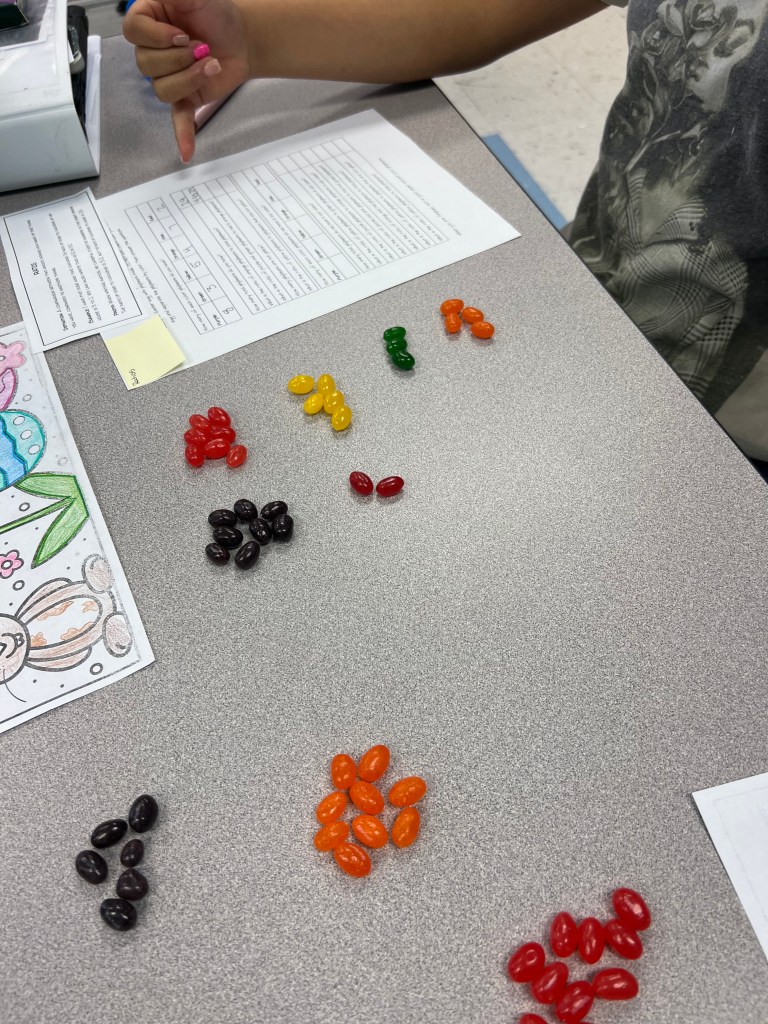
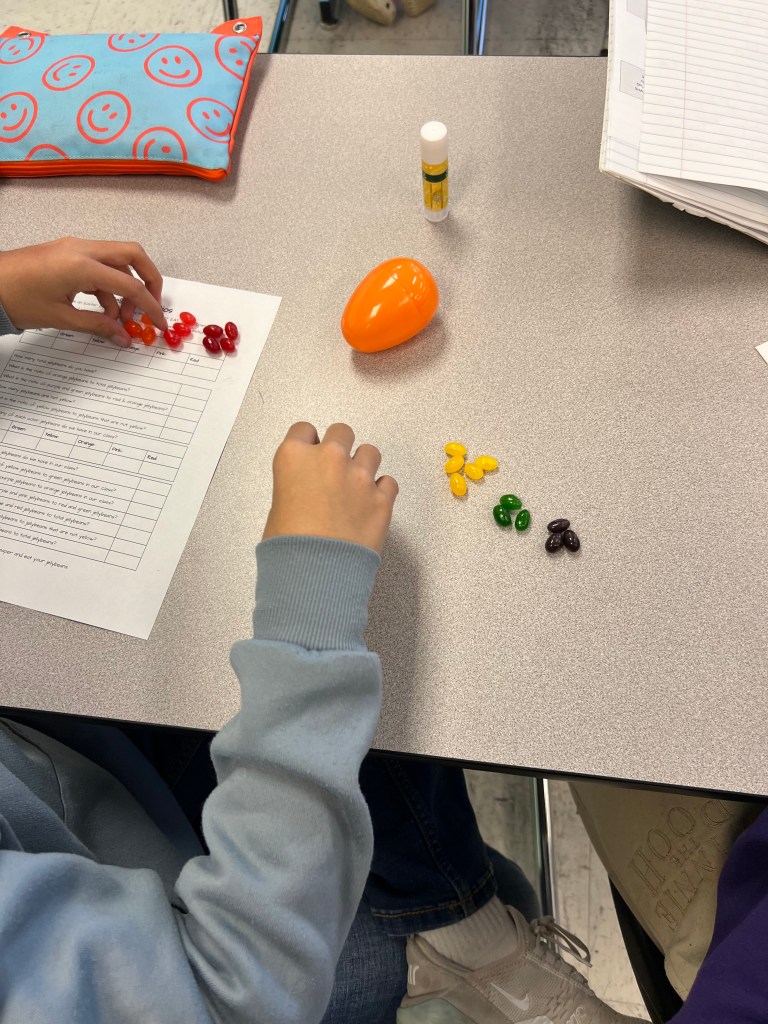
Some of my students are starting a unit on ratios, so I gave them a sweet lesson: I brought in plastic Easter eggs full of jellybeans and instructed them to sort the jellybeans by color, complete a table showing the number of each color they had, and then answer a series of questions:

  • How many total jellybeans do you have?
  • What is the ratio of orange jellybeans to total jellybeans?
  • What is the ratio of purple and green jellybeans to red and orange jellybeans?
  • How many jellybeans are not yellow?
  • What is the ratio of yellow jellybeans to jellybeans that are not yellow?

Once they had their individual jellybeans sorted, I helped them get their class totals, which they entered into a new table, and then they used those numbers to solve a second series of problems:

  • How many total jellybeans do we have in our class?
  • What is the ratio of yellow jellybeans to green jellybeans in our class?
  • What is the ratio of purple jellybeans to orange jellybeans in our class?
  • What is the ratio of purple and pink jellybeans to red and green jellybeans?
  • What is the ratio of orange and red jellybeans to total jellybeans?
  • What is the ratio of yellow jellybeans to jellybeans that are not yellow?
  • What is the ratio of yellow jellybeans to total jellybeans?

Once they completed the assignment, we checked our answers, and then they were allowed to eat their jellybeans.

You can use any type of candy for this activity, as long as it comes in multiple colors and isn’t too messy. I’ve used M&Ms, Starbursts, Skittles, and jellybeans with equal success. Fruit-flavored Tootsie Rolls and Laffy Taffy would also work. I chose jellybeans this time around because A.) I have a student with an allergy that renders M&Ms unsafe, and B.) jellybeans are cheap right now because it’s almost Easter.

Every time I’ve done this activity, I’ve gotten 100% engagement. There’s nothing like the prospect of free candy to get kids invested in a lesson. It’s a very Montessori sort of activity, too, because it involves multiple senses: The kids are looking at the candy, reading and listening to the instructions, discussing their answers, handling the candy as they sort it by color, and (their favorite) tasting and smelling the candy when they get to eat it at the end of the lesson.