


Posted in Classroom environment, Classroom reveal, Decor, Student engagement, Whimsy

Chapter 77: Classroom Reveal 2025

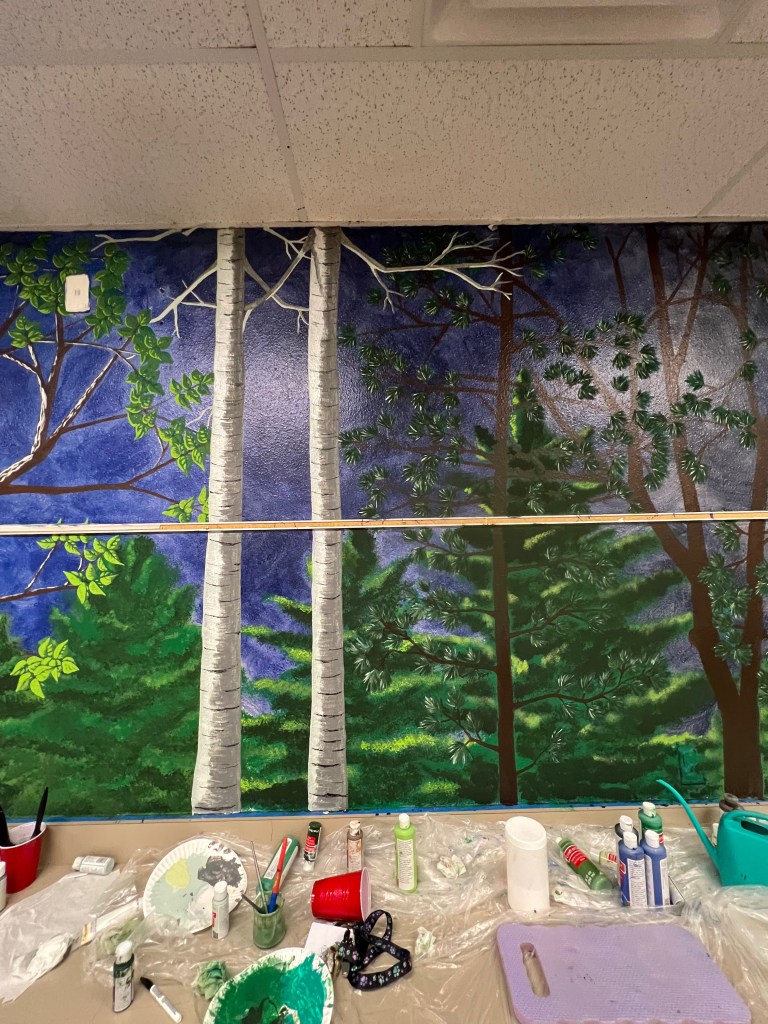
I didn’t bother with a classroom reveal last year, because frankly, my classroom was a bit underwhelming. After a year of dodging reckless drivers on I-40, I decided the risk of flaming death was just a little too high for my comfort, so in the spring of 2024, I applied for a job teaching sixth-grade ELA at a school much closer to home. It was a great assignment, except for one glaring problem: I couldn’t convince the upper-level administrators to let me paint my room, so I had to settle for fairy lights and whimsical bulletin boards. The kids and their parents were impressed, but I wasn’t. Temporary wall hangings feel hopelessly liminal to me, and liminal spaces have an aura of wrongness about them that no amount of wishful thinking will overcome.

After my kids posted stellar scores on the middle-of-year benchmark test, I went to our then-superintendent — who was new to the district and very enthusiastic about Doing Things Differently, and whose support I’d been cultivating for several months — and asked again.

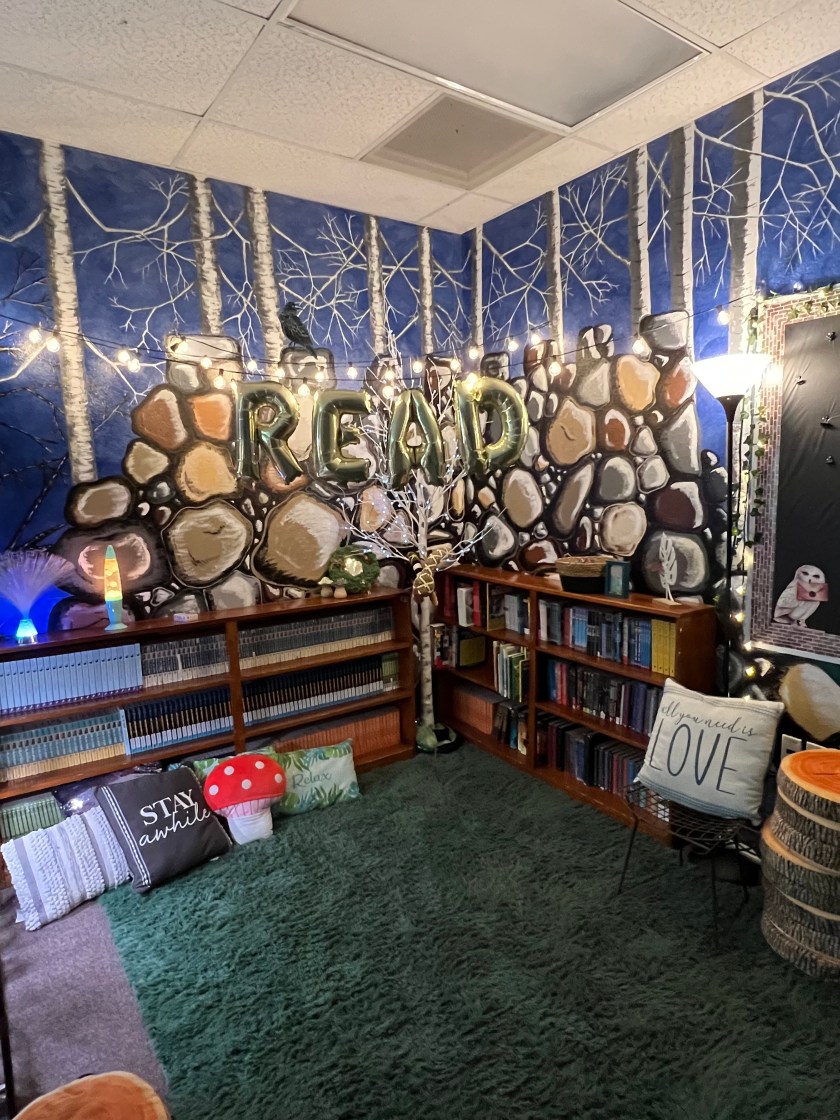
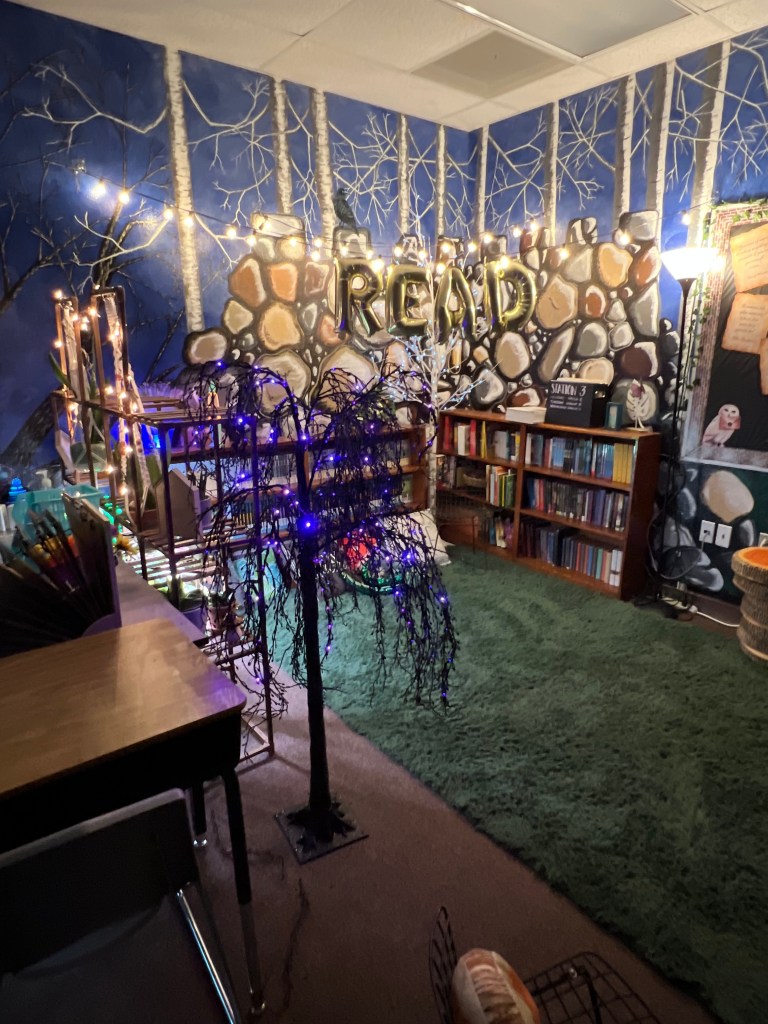
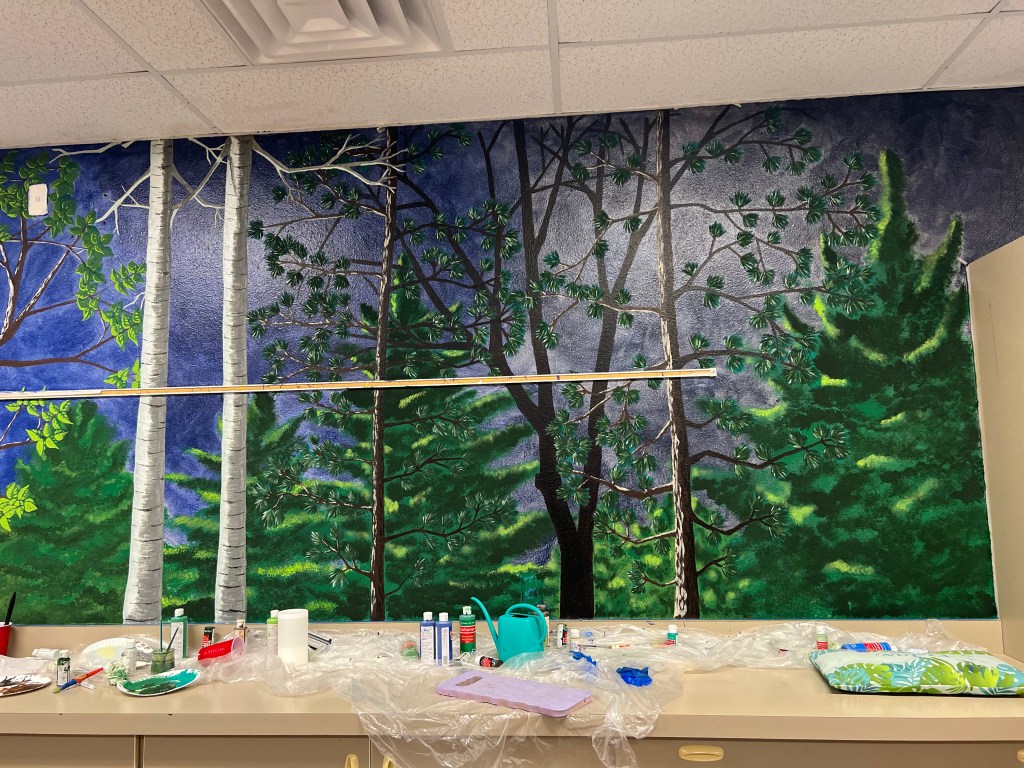
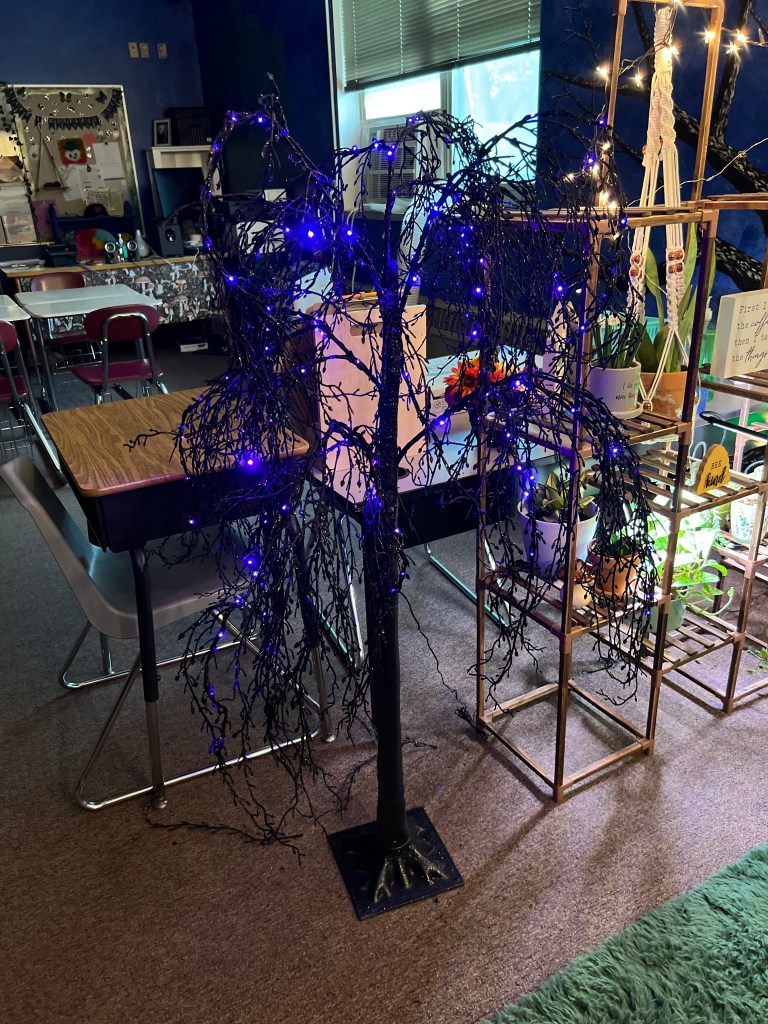
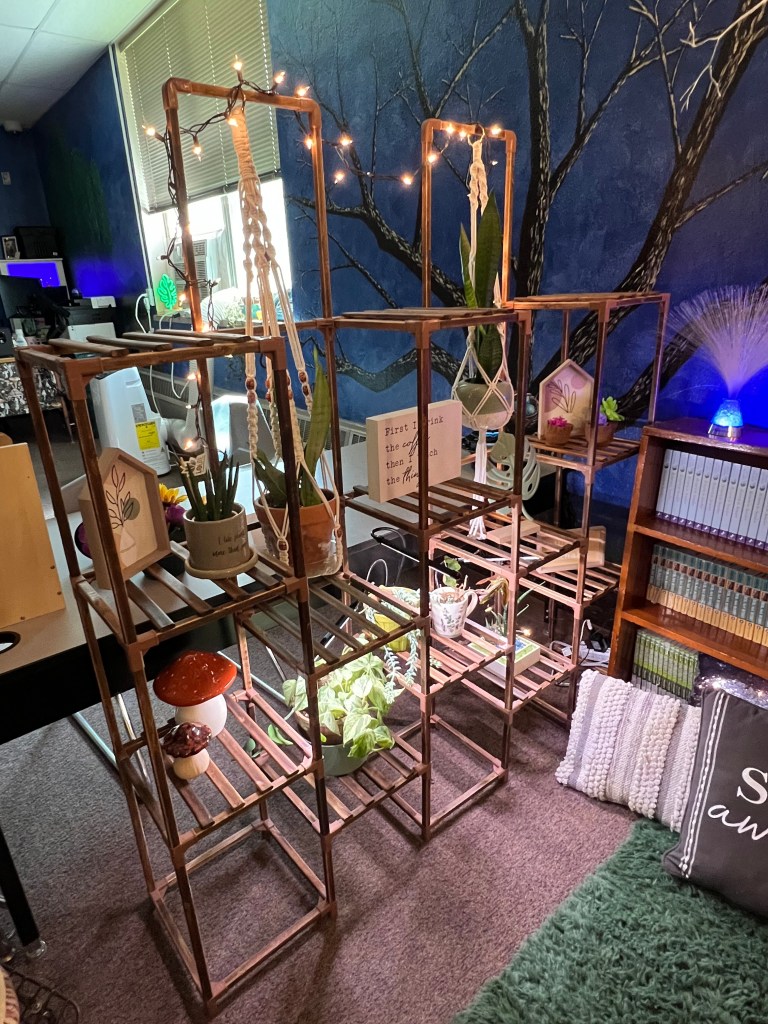
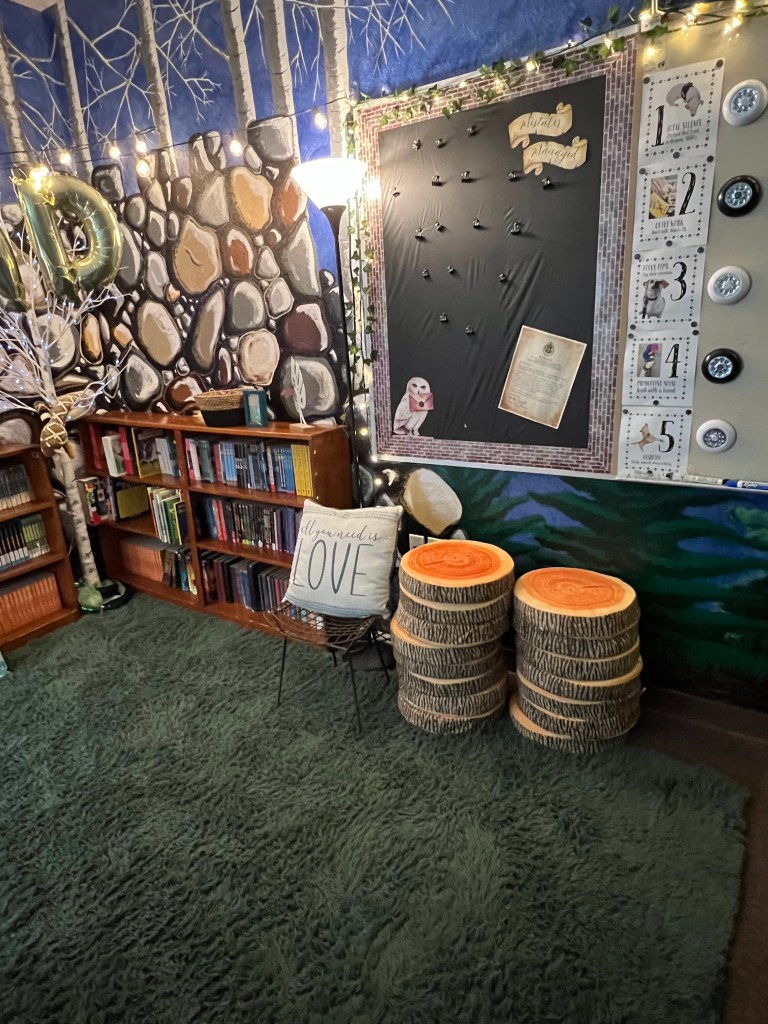
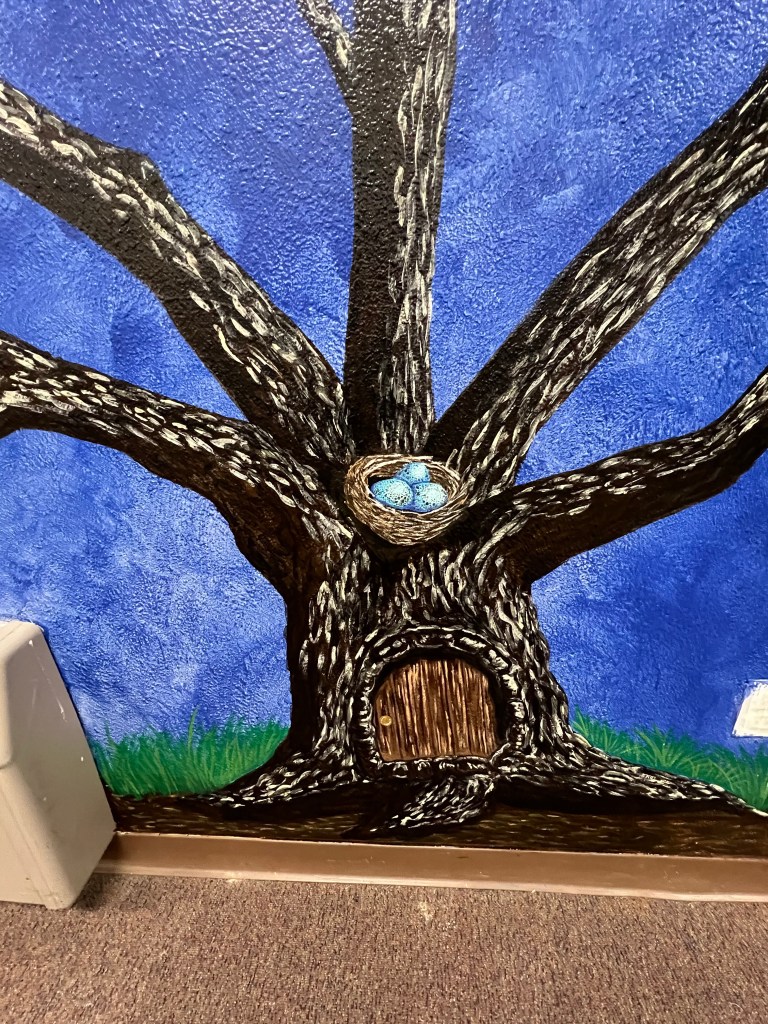
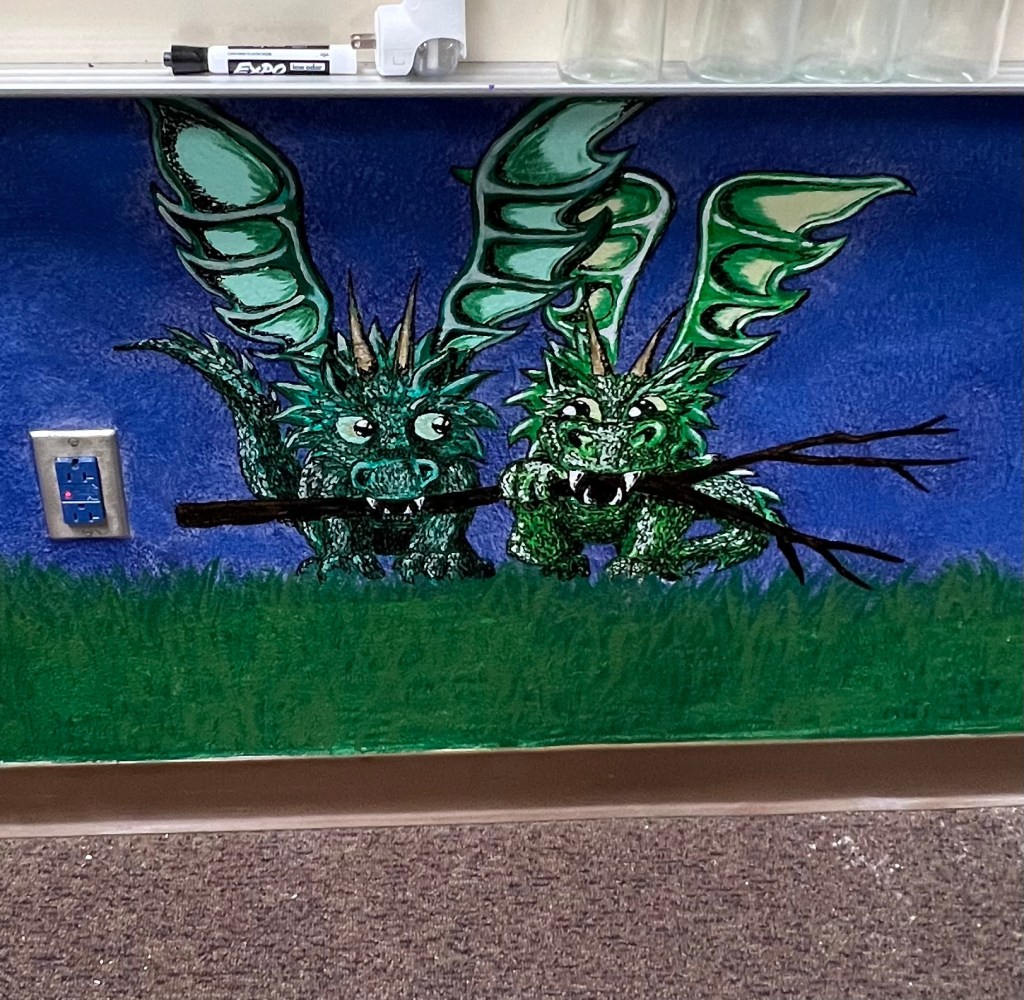
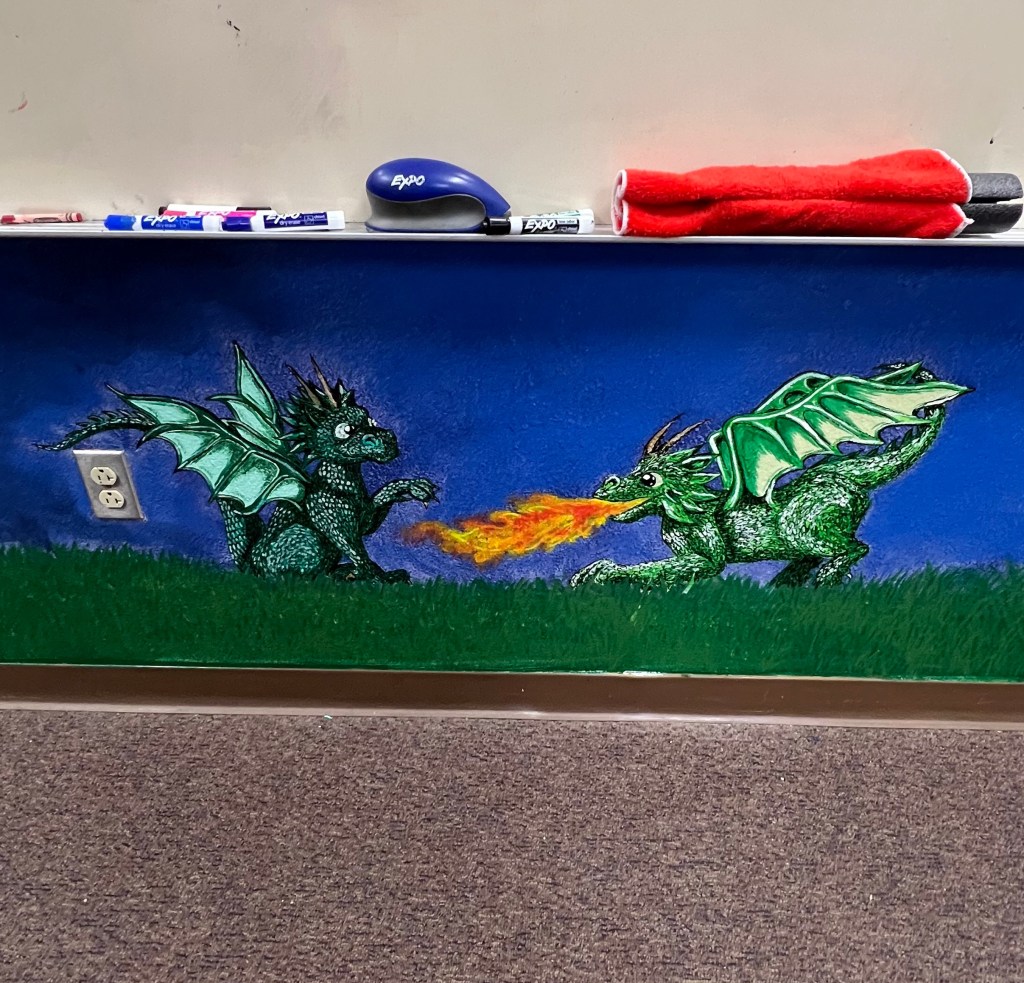
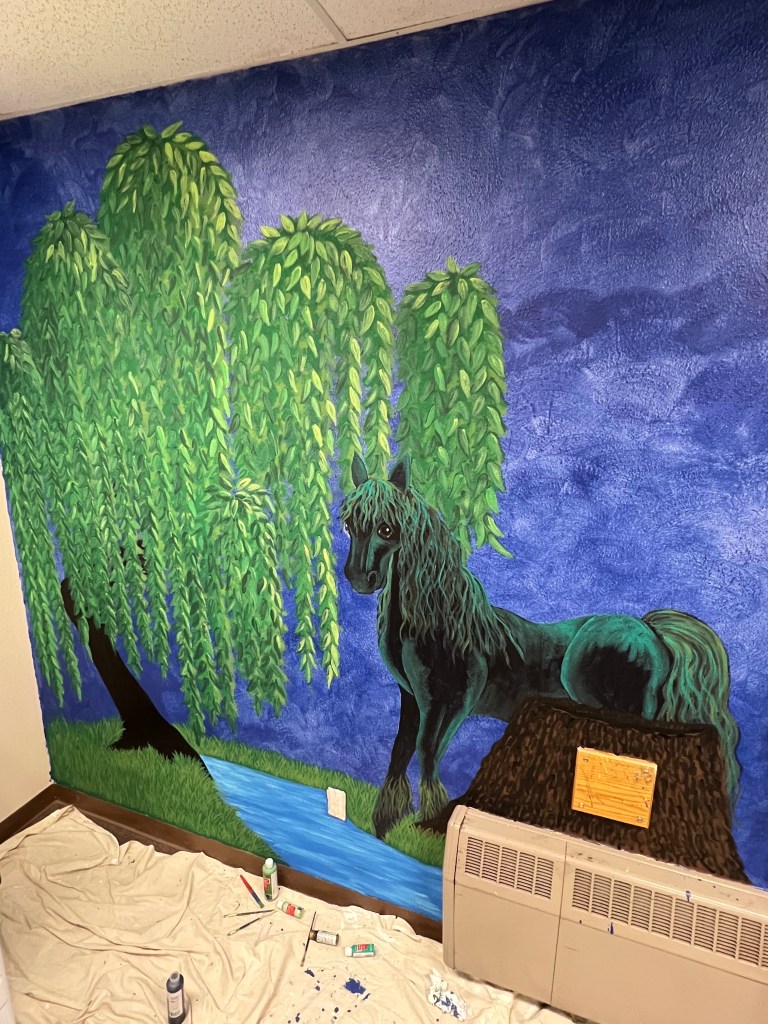
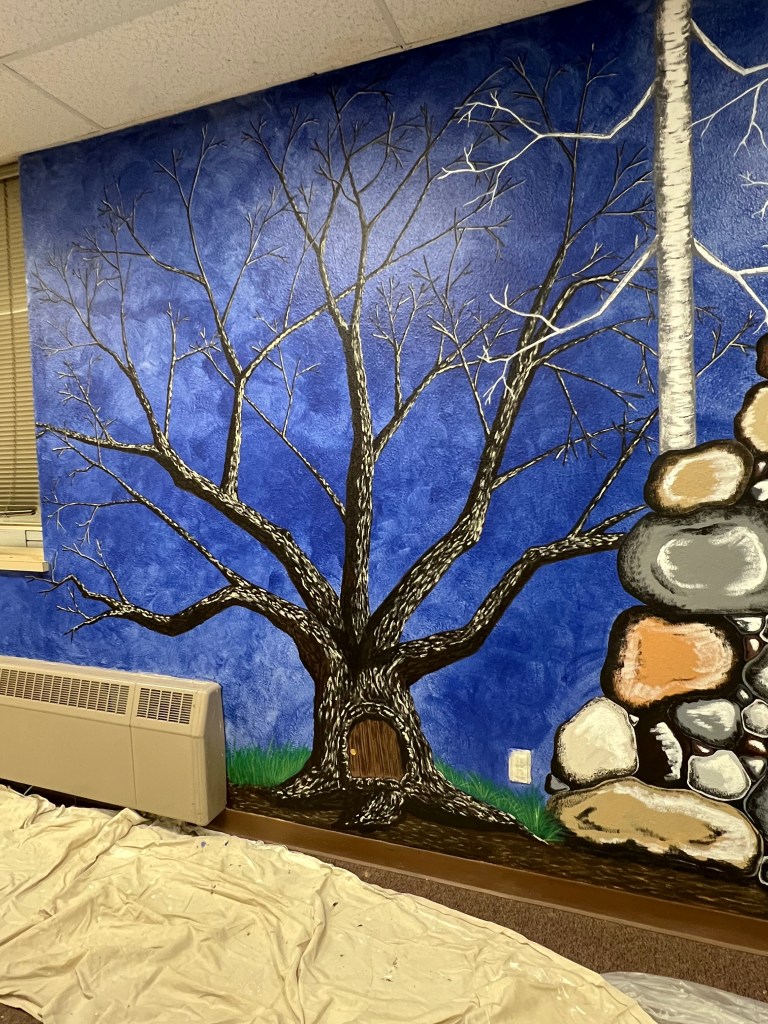
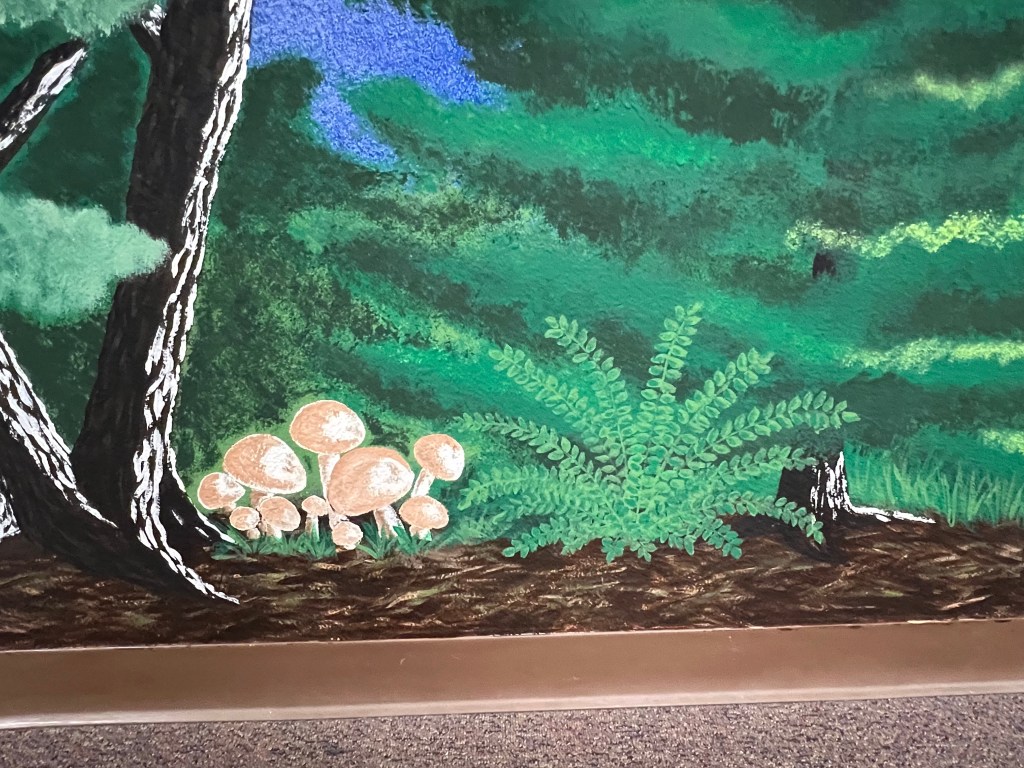
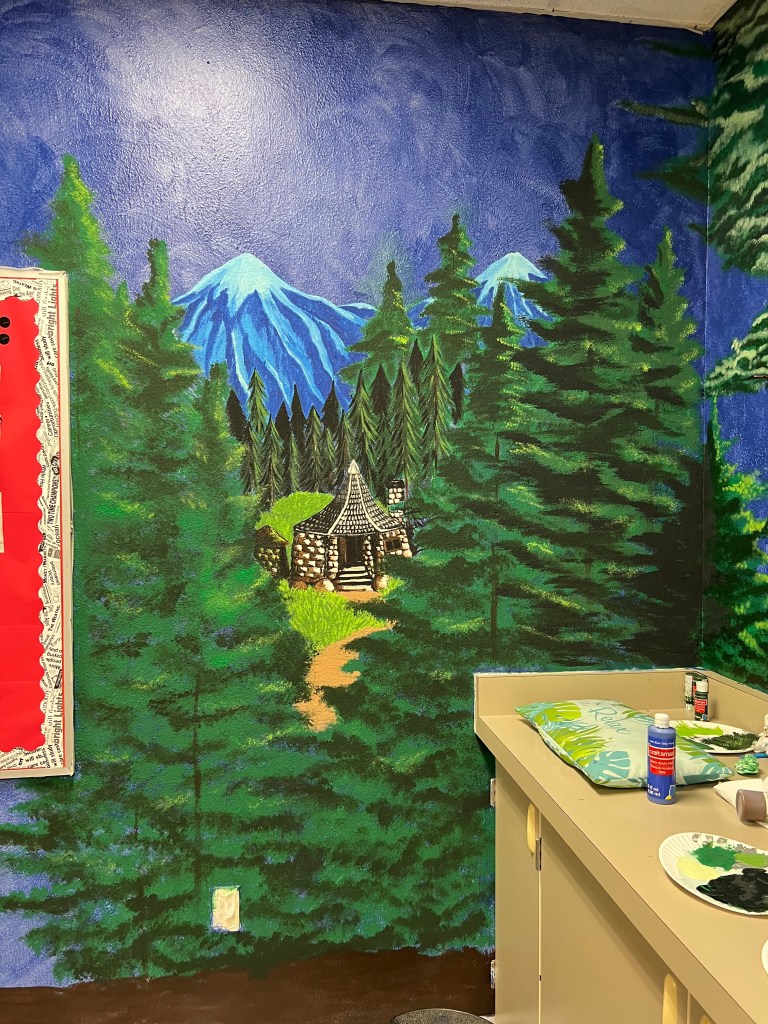
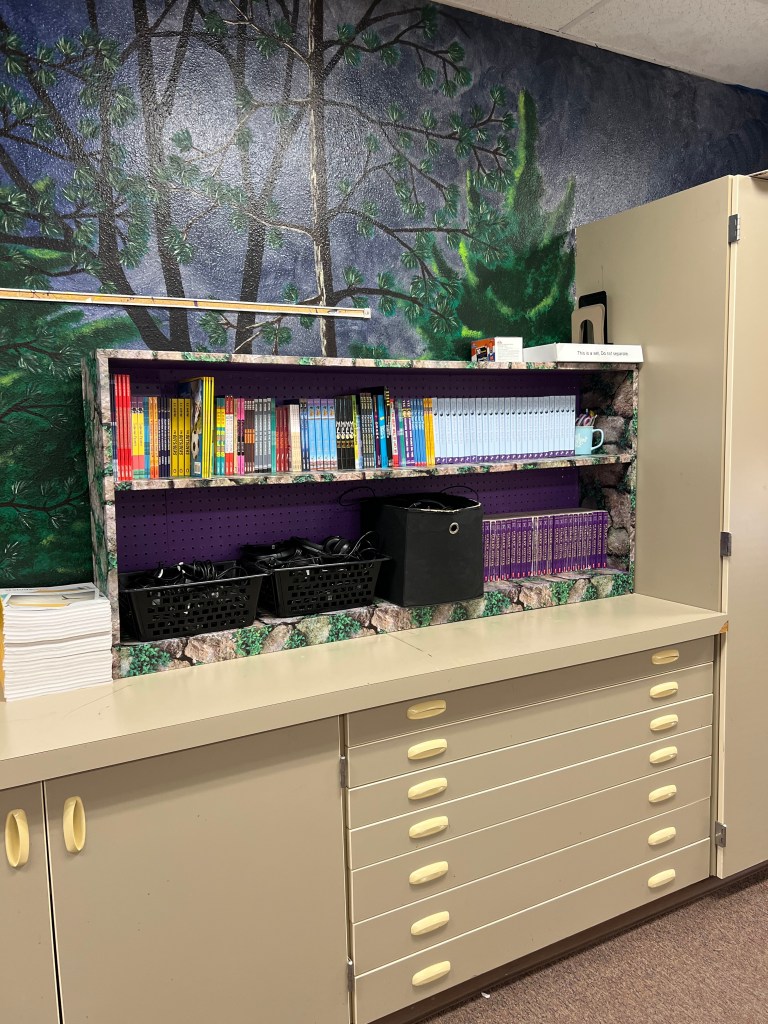
Welcome to the enchanted forest, where dragon puppies frolic below a whiteboard, a deceptively cute kelpie dips a toe into a stream running next to my desk, a spooky old tree sports a clutch of raven’s eggs and a likely portal to the Otherworld (conveniently tucked out of sight under a worktable), and the bookcases lean against the stone remnants of some long-forgotten castle, watched over by a raven who may or may not be* an incarnation of a Celtic battle goddess. In a nod to my Potterheads, I also tucked Hagrid’s hut into a little clearing behind some evergreens, and there’s enough open space here and there for me to add flourishes later if the mood strikes me.

The kids love it, and it’s making the workstation format that I’m using this year way more fun than it has any right to be. Three days a week, the kids work in small groups, rotating to a different workstation each day — one focused on writing, one on mechanics, and one on reading. The reading station is in the corner, where they sit on log-slice pillows atop a fluffy green carpet and relax while they learn to annotate the stories they read. On Thursdays, we do whole-group activities, and the kids who are all caught up on their work get to sit on the same carpet and read to my three-legged spaniel mix, Pearl, who was certified as a therapy dog last year. (I’ll have another post on that soon.)

If you can convince your administration to let you paint murals in your classroom, I highly recommend it. A little creativity makes a big difference.

Emily

* Is, of course. My master’s thesis was a novel about a 10-year-old banshee who discovers she is the latest incarnation of the Morrigan. Shapeshifting is one of her powers, and — in keeping with Celtic mythology — she frequently takes the form of a raven.
Posted in Hands-on activities, Learning styles, Math, Sensory, Student engagement, Tactile

Chapter 74: Jellybean Ratios

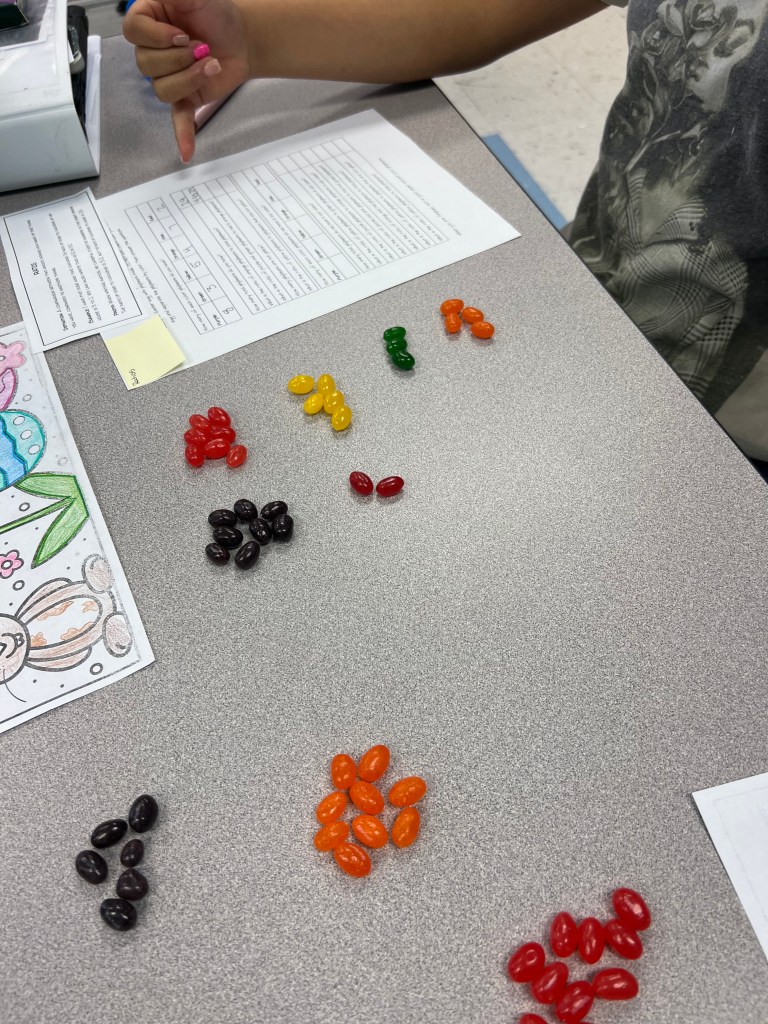
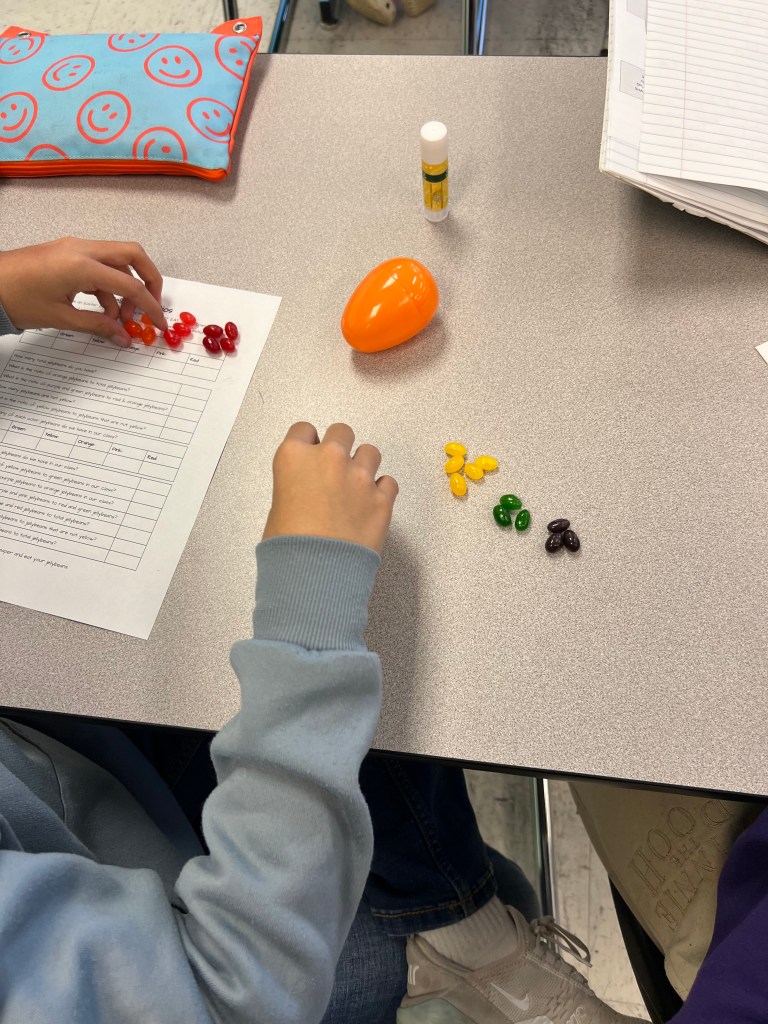
Some of my students are starting a unit on ratios, so I gave them a sweet lesson: I brought in plastic Easter eggs full of jellybeans and instructed them to sort the jellybeans by color, complete a table showing the number of each color they had, and then answer a series of questions:

  • How many total jellybeans do you have?
  • What is the ratio of orange jellybeans to total jellybeans?
  • What is the ratio of purple and green jellybeans to red and orange jellybeans?
  • How many jellybeans are not yellow?
  • What is the ratio of yellow jellybeans to jellybeans that are not yellow?

Once they had their individual jellybeans sorted, I helped them get their class totals, which they entered into a new table, and then they used those numbers to solve a second series of problems:

  • How many total jellybeans do we have in our class?
  • What is the ratio of yellow jellybeans to green jellybeans in our class?
  • What is the ratio of purple jellybeans to orange jellybeans in our class?
  • What is the ratio of purple and pink jellybeans to red and green jellybeans?
  • What is the ratio of orange and red jellybeans to total jellybeans?
  • What is the ratio of yellow jellybeans to jellybeans that are not yellow?
  • What is the ratio of yellow jellybeans to total jellybeans?

Once they completed the assignment, we checked our answers, and then they were allowed to eat their jellybeans.

You can use any type of candy for this activity, as long as it comes in multiple colors and isn’t too messy. I’ve used M&Ms, Starbursts, Skittles, and jellybeans with equal success. Fruit-flavored Tootsie Rolls and Laffy Taffy would also work. I chose jellybeans this time around because A.) I have a student with an allergy that renders M&Ms unsafe, and B.) jellybeans are cheap right now because it’s almost Easter.

Every time I’ve done this activity, I’ve gotten 100% engagement. There’s nothing like the prospect of free candy to get kids invested in a lesson. It’s a very Montessori sort of activity, too, because it involves multiple senses: The kids are looking at the candy, reading and listening to the instructions, discussing their answers, handling the candy as they sort it by color, and (their favorite) tasting and smelling the candy when they get to eat it at the end of the lesson.

Posted in Differentiated instruction, Hands-on activities, Kinesthetic, Learning styles, Math, Student engagement

Chapter 71: Batter Up!

My seventh-graders did another baseball-themed lesson today. This one was really fun: We went to the gym and took batting practice with a wiffle ball and bat. The rules were a variant on the coach-pitch munchkin league softball my little sister played in the late ’80s and early ’90s: I gave every batter seven pitches, and each pitch had three possible outcomes — strike, foul, or hit. Any contact that wasn’t foul was recorded as a hit, and any pitch that didn’t result in contact was recorded as a strike, regardless of how good or bad a pitch it was.

Each student took a turn batting while the rest of the class recorded the outcome of each pitch on a chart that included columns for the batter’s name, each of the seven pitches, the batter’s total hits, and the batter’s contact rate. After we got through the lineup, we returned to class and got out our calculators. The kids counted the hits for each batter, then divided the hits by seven (the total number of pitches) to get a makeshift batting average. Once they had calculated all of the numbers for all of the batters, they used them to calculate the class average.

This was one of those days when I ended up with 100% engagement, and the kids were spectacularly cooperative: silent in the hall on the way to and from the gym, efficient when they reached the gym — no dawdling or horsing around between batters, and I had a couple of ballplayers chasing down balls for me so I wouldn’t have any long delays between pitches — and completely invested in the math when we returned to my classroom. I was especially pleased when I noticed several of the kids helping their classmates by filling in their stats when they were batting. This was completely voluntary — they just started doing it on their own — and wound up being a great timesaver because the batters didn’t have to stop and copy down their own stats after each at-bat.

I love it when my instincts are right, and a lesson that sounds great on paper lives up to its potential.

Posted in Hands-on activities, Math, Student engagement

Chapter 70: Sabermetrics

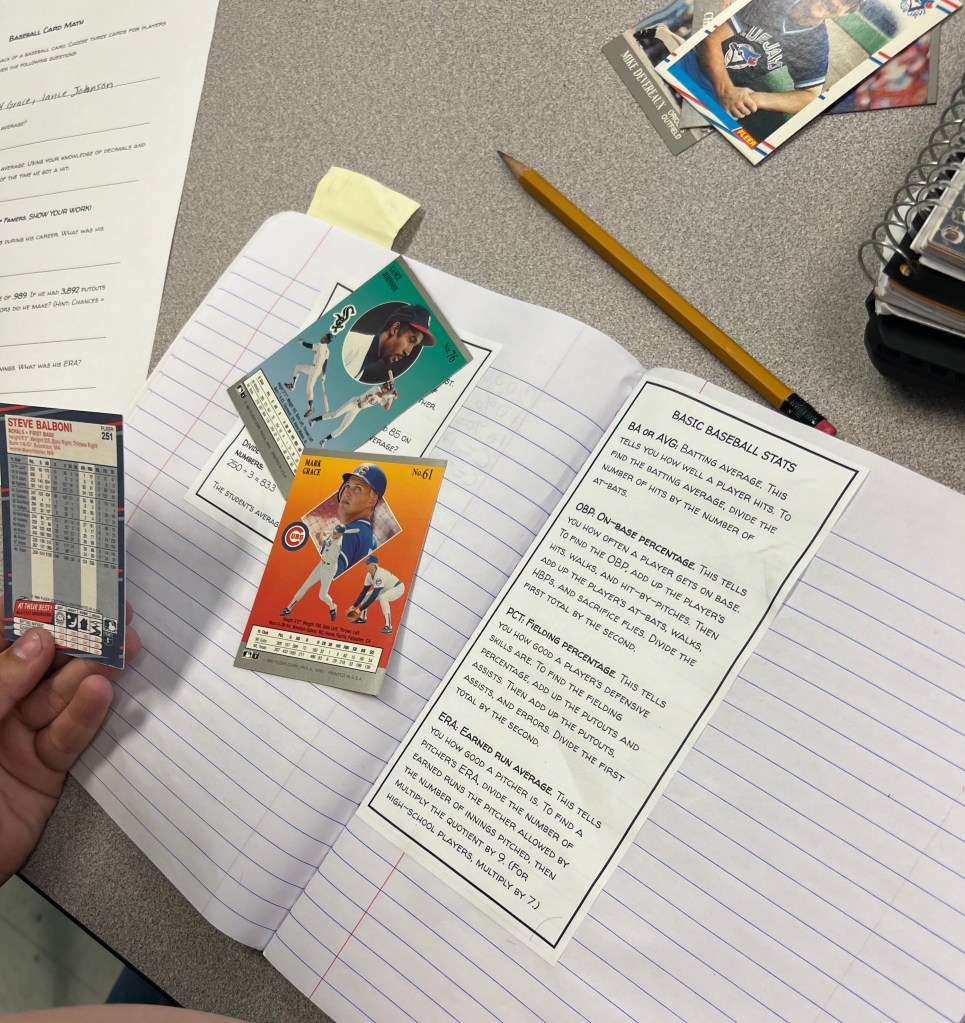
It had been YEARS since I had an excuse to break out a pack of baseball cards in class, but this week, we had a rudimentary lesson on sabermetrics (the study of baseball statistics) to reinforce what my seventh-graders have been learning about ratios, percentages, and averages.

For the first lesson, I did a quick overview of three relatively simple stats: batting average, fielding percentage, and ERA. Each of these stats is pretty easy to understand and to calculate.

I made a cheat sheet with the definition and formula for each stat, plus OBP (which we didn’t end up using for this lesson but might play with later), and had the kids paste it into their notebooks so they’d have everything they needed to work with the numbers.

I used to have a pretty respectable baseball card collection, but I gave it to my softball-obsessed goddaughter and her older sister about 10 years ago, when I didn’t think I’d be teaching math again, so my first order of business was to scrounge up some cards. I found a bundle of seven old ’80s and ’90s wax packs on Amazon for $11.50 and let the first group of students have the fun of opening the packs to see what was inside (with a careful admonition not to chew any gum they found inside, as it was likely to be older than their parents).

I put the kids in groups of two or three and gave each group a wax pack and a handout containing the following text:

Baseball Card Math

There’s a lot of math on the back of a baseball card. Choose three cards for players who are not pitchers and answer the following questions:

1. Who are your three players?
2. Which player has the best batting average?
3. Choose one player. Look at his batting average. Using your knowledge of decimals and percentages, determine what percentage of the time he got a hit.
Now, let’s look at some of my favorite Hall of Famers. SHOW YOUR WORK!
4. Ted Williams had 2,654 hits in 7,706 at-bats during his career. What was his lifetime batting average?
5. Ryne Sandberg has a lifetime fielding percentage of .989. If he had 3,892 putouts and 6,648 assists in 10,660 chances, how many errors did he make? (Hint: Chances = putouts + assists + errors.)
6. Mariano Rivera allowed 315 earned runs in 1,283.2 innings. What was his ERA?

Question 2 seemed easy enough, but I quickly realized that most of the kids had no idea how to find information on the back of a baseball card, so we had to do a quick mini-lesson on that. (Fleer’s weird habit of using “PCT” to mean batting average instead of fielding percentage didn’t help.) Question 3 tied into our recent study of percentages, while Question 4 helped build their confidence. Question 5 was a bit of red herring, because the kids’ cheat sheets contained the formula for calculating fielding percentage, but the question itself really only required them to find the difference between Sandberg’s chances and his successful plays. The math is easy, but they had to slow down and think about the question, which is challenging for them. Meanwhile, Question 6 was easy for the kids who referred to their notes, but those who tried to work from memory got it wrong because they forgot to multiply the ratio of ER to IP by 9 to get the answer.

Assuming the kids cooperate, tomorrow’s lesson — which is based on one I did about 12 years ago in Tulsa — should be even more fun. If it goes smoothly, I’ll share it.

Posted in Collaborative learning, Competition, Math, Student engagement, Success

Chapter 68: Road Trip!

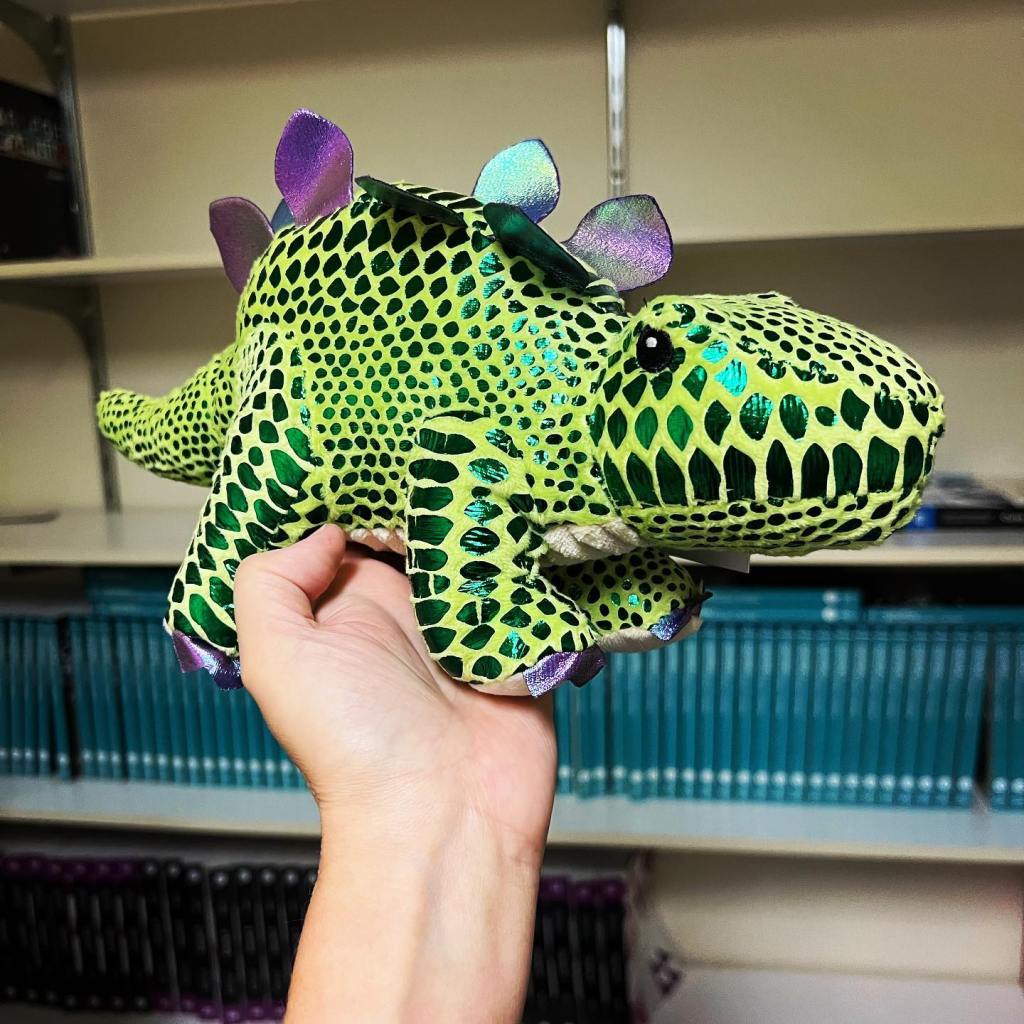
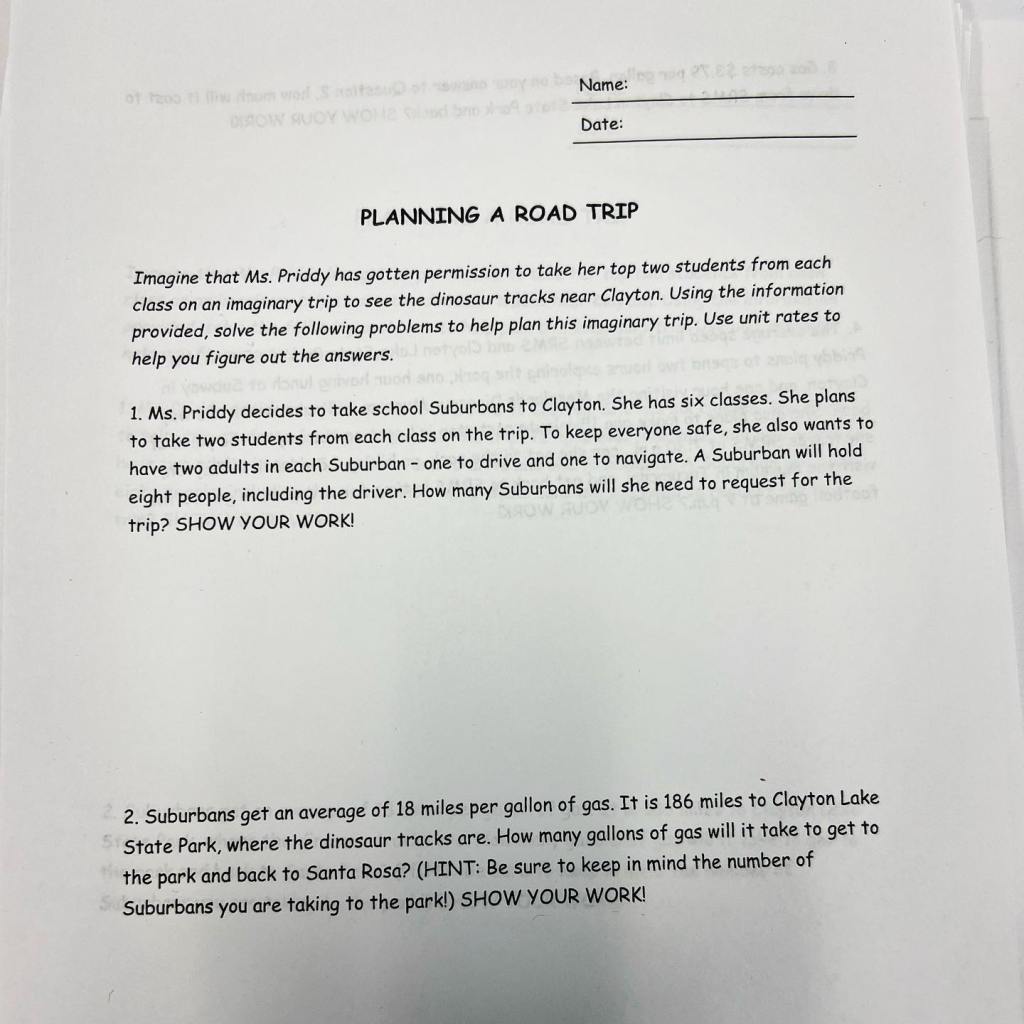
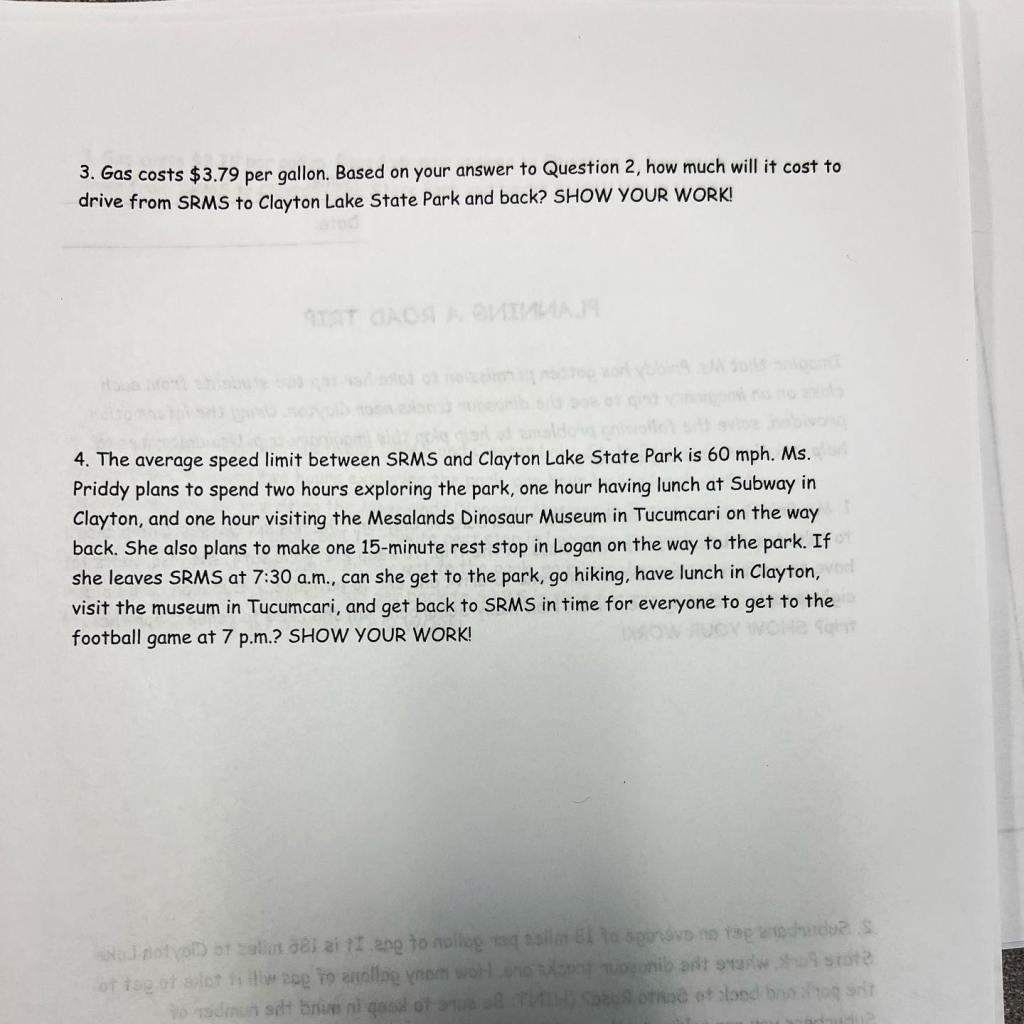
Kids sometimes have trouble understanding why they need to learn math, especially if it’s challenging, so I spend a lot of time looking for ways to make it relevant to their interests. To that end, I like to incorporate an imaginary road trip into their study of unit rates. This particular group struggles with motivation, so I planned an imaginary trip to Clayton Lake to see the dinosaur tracks and asked them a series of four questions about gas mileage, expenses, speed, and itinerary. They worked in small groups to answer the questions, and the first team to answer all four questions correctly earned dinosaur plushies.

My kids love dinosaurs, competition, working in groups, and getting stuff for free, so a team competition with free dinosaurs on the line yielded 100% engagement. Better still, the kids saw the practical application for the math they were learning, which means they’ll be more likely to remember it and use it later.

Below are the questions we used. If you do something similar in your classroom, you’ll obviously want to choose a location in your area and use Google to get the distances, prices, etc., but this gives you a rough idea of how I put this together.

You can get more elaborate if you want. Last year, when my sixth-graders were learning ratios, I put together a multi-day unit that involved planning every detail of an imaginary trip from House, New Mexico, to Holbrook, Arizona, to go hiking in the Painted Desert. We figured up mileage, meal costs (including tip and tax), gas prices, lodging, travel time, bottled water usage, and I don’t remember what all else. It was a long unit, but the kids really got into it — especially after the owner of our chosen lodging establishment, the Wigwam Motel, was kind enough to send them some key tags and postcards to keep as souvenirs of their imaginary trip.

I didn’t have as much time available this year, so I kept our trip short and simple, but the kids still had a good time. If you’re looking for a way to make unit rates understandable, I can highly recommend this approach.

Emily

Posted in Collaborative learning, Competition, Differentiated instruction, Games, Instructional design, Kinesthetic, Learning styles, Math, Student engagement, Test prep

Chapter 66: On Target

I have a love-hate relationship with school breaks. On the one hand, they’re a chance to decompress, catch up on some projects at home, do some advance planning, and spend some time with my dogs. On the other hand, they’re a monumental disruption that distracts the kids and makes it extremely difficult to get them to concentrate on anything long enough to learn.

This ain’t my first rodeo, so I got wise this year and didn’t bother attempting to teach anything new the week before spring break. Instead, I devoted the entire week to activities meant to reinforce concepts the kids had already mastered: a catch-up day on Monday to help my frequent absentees backfill those last few holes in the gradebook ahead of report cards; a doodle-by-numbers activity I pulled off Teachers Pay Teachers to review angle-sum rules; an Easter-egg hunt with math problems inside the eggs and a key that required the kids to find the correct answers in order to get their next clue; and a low-prep darts game we’ve played a time or two in the past.

The game is very simple. Get yourself a ball-darts game and a bunch of math problems over whatever the kids have been learning recently. I bought the dartboard you see in the picture from Amazon earlier this year. The kids like it because the board and the balls all light up.

Divide the class into two teams (if you have an odd number of kids, choose one to be your scorekeeper) and have them form two lines. The first kid on Team 1 throws a ball at the dartboard to determine the point value for the first question. Kid 1 can confer with the rest of the team about the answer to the question, but Kid 1 is the only person allowed to answer it. If Team 1 misses, Team 2 has a chance to rebound before throwing the ball and answering a question of their own.

I like this game a lot because it’s high-engagement; gives struggling learners a chance to practice with help from their classmates; meets the kids’ social needs; and requires no prep beyond downloading a worksheet and printing it out to use as your question bank. (Protip: If you need a bunch of questions quickly, search Teachers Pay Teachers for your concept + “drill” to find practice problem sets.)

If you want to send your engagement through the roof, keep a supply of dollar-store prizes on hand and award a small prize to the winning team. (For my middle-schoolers, I’ve found candy and anything dinosaur-themed to be popular prizes, but your mileage may vary.)

Posted in Hands-on activities, Instructional design, Kinesthetic, Learning styles, Math, Student engagement

Chapter 63: The Force Is Strong With These

My eighth-graders used a lightsaber to help them remember the difference between positive and negative integers. I threw some simple addition and subtraction problems on the board and had them take turns walking along the number line, pointing with the lightsaber, as they counted off numbers to solve the problems. Everything to the left of zero was the Dark Side, and everything to the right was the Light Side. The Star Wars analogy was silly, but they had fun with it, and it helped them remember the difference.

If you teach math, and you don’t already have one, I highly recommend making a number line that the kids can see from across the room and posting it on the wall above your whiteboard. Physically walking along the number line really helps the kids get their heads around integers.

Posted in Differentiated instruction, Special ed, Student engagement, Success, Teachable moments, Winning

Chapter 53: Community Policing

A few weeks ago, a pair of sheriff’s deputies paid a visit to our campus. Visits from LEOs aren’t unheard of, but they’re not super common, either, and the sight of two uniformed officers walking into my classroom startled a student who is still learning some social skills and isn’t comfortable with surprises.

I told him the deputies were just there because they were hoping he’d read them a story. (He’s been working on his fluency a lot lately, so I hoped he’d take the bait.) I asked the deputies to sit down and give him a little space while he processed the situation, which they kindly did. Right about then, his mom arrived to pick him up from school, but the deputies stuck around for a bit, and before they left, I got their names and a mailing address for the sheriff’s office.

The next day, my student wrote a letter inviting them back to hear him read, and when I saw one of the deputies at a school event a few days later, I asked him to give me a heads-up before their next visit so I could be sure my student wasn’t caught off-guard.

I got a text from him yesterday morning, saying they were going to be on campus later. I was out sick but immediately notified my boss, who ensured my student was prepared.

This morning, when I returned to school, my student greeted me with the news that he’d read to his new friends, and they had promised to return with patches for him and his classmates one day soon. He even got out his iPod and proudly showed me a video someone had taken of him reading and joking with them.

I’ve worked for newspapers in three states. I’ve spent a lot of time at crime scenes. I’ve met some pretty great cops. And I think I speak with authority when I say: This is EXACTLY how community policing is supposed to work.

Thanks to the patience of two friendly deputies, my student’s perception of law enforcement has changed from one of fear (which could lead to potentially dangerous misunderstandings when he is older) to one of camaraderie. Bonus: He got to practice reading and socializing a little bit in the process. And he is hella excited about that patch.

I hope he made their day as much as they made his.

Emily

Posted in Common Core, Student engagement, Tools, Whimsy

Chapter 44: A New Hope

starwars

OMG, you guys. I just found THEEEEEEEE most ridiculous way to display my Common Core objectives on the Promethean board next fall: the Star Wars Crawl Creator.

It won’t let me save text I enter, so I’ll have to put the daily objectives in a Word file and just copy and paste them in on the fly, but I am HOWLING as I imagine my hilarious incoming sophomores sitting down, looking up at the board, and seeing their objectives scroll up the screen in George Lucas style while John Williams’ famous theme song plays dramatically in the background.

Three days into summer, and I’m already nerding it up. I don’t even know what to say for myself.

Emily