Posted in Classroom environment, Classroom management, Sensory

Chapter 76: Dia duit!

Dia duit! (That’s Irish Gaelic for “good morning.”)

I had a very good morning Thursday, and a very good afternoon, too, despite it being the day before Easter break. There were several reasons for this, but I think the main one was the set of Celtic music CDs I found in the free basket in the teachers’ lounge.

I had to track down a CD player, because there isn’t one on my computer, but Ron had an external drive that he let me use, and I spent part of Thursday morning ripping music to my hard drive while the kids were busy with club meetings.

Then I did a magic trick.

This is an old trick that I’ve heard other teachers mention favorably, but it’s one I’ve never used before, and it worked way better than I anticipated: I turned the music to a low volume — loud enough to hear when the room is quiet, but not loud enough to be distracting — and told the kids to keep their voices soft enough to hear the music in the background.

I’ve never heard them quieter.

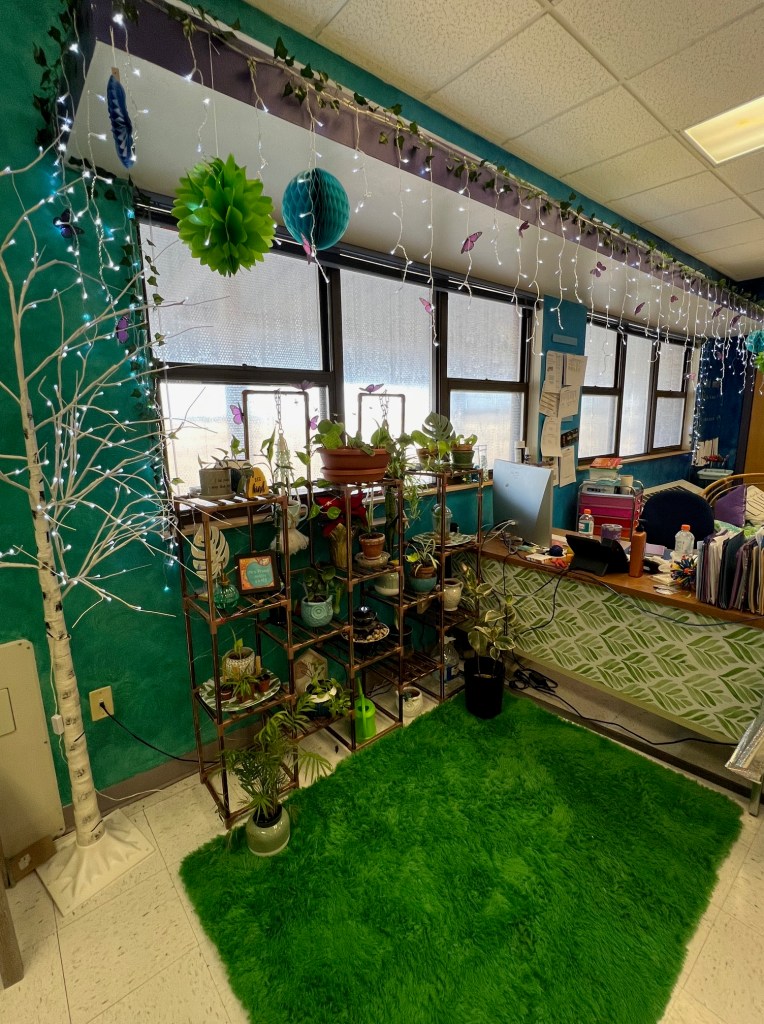
The music was nice — very soothing, and a great addition to that sensory-friendly “Nature Company, ca. 1997” vibe I’m trying to cultivate in my room — but I think what really kept them quiet was the fact that we now have a tool to help them self-police. If I say, “You’re too noisy; please quiet down,” they’re skeptical. How do I know they’re too noisy? What does that even mean? “Too noisy” is completely subjective. But if I say, “Guys, I can’t hear the music,” they can listen for a second, confirm that the music is, indeed, inaudible above the din, and make adjustments on their own.

I wish I’d done this in August. My whole year probably would have been easier. I’m definitely keeping this idea for future use.
Posted in Exit tickets, Eyewash, Metacognition, Timesavers, Whimsy

Chapter 75: Emoji Exit Ticket

Confession: I hate exit tickets.

The theory behind them is solid, but in practice, they are largely incompatible with my teaching style, for two reasons:

  1. I am the reigning queen of ADHD time blindness. I barely notice the bell signaling the end of class, and you think I’m going to remember to stop two or three minutes early so the kids can complete an exit ticket? Oh, you sweet, summer child.
  2. One of the biggest strengths of my teaching style is its flexibility. If we’re playing a game, or I’m in the middle of explaining something to a student who asked a last-minute question, or the kids are deeply invested in a class discussion, it would be silly to interrupt that to do something less engaging just so I can check a box on my lesson plan. Good teaching is about knowing when to switch activities and when to say, “Meh. This is better than what I came up with for today. Let’s just roll with it.”

That said, consultants and instructional coaches LOVE exit tickets and will extol their virtues with evangelical zeal at every opportunity. Rather than waste time arguing with fangirls, I simply include a line on every lesson plan that says, “Closer: Exit ticket (5 min.)” and keep a supply of four or five different types and styles of exit tickets on hand to whip out on those days when my executive functioning decides to report for duty. I spent part of one weekend prepping these in bulk so I’d have them available for instant use, which is much easier than trying to remember to prep a kajillion little slips of paper every week.

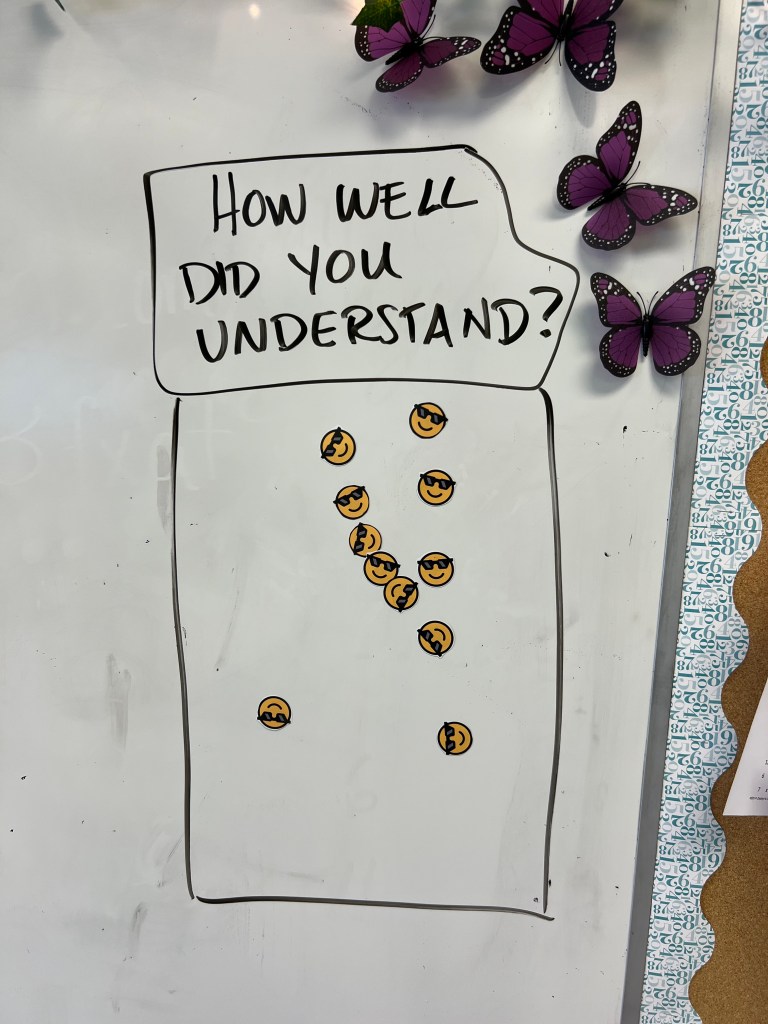
One of my favorites took the better end of an hour to prep, but it’s reusable, memorable, visually interesting, and involves metacognition, which is another fashionable buzzword. If you want to make your own, here’s what you do:

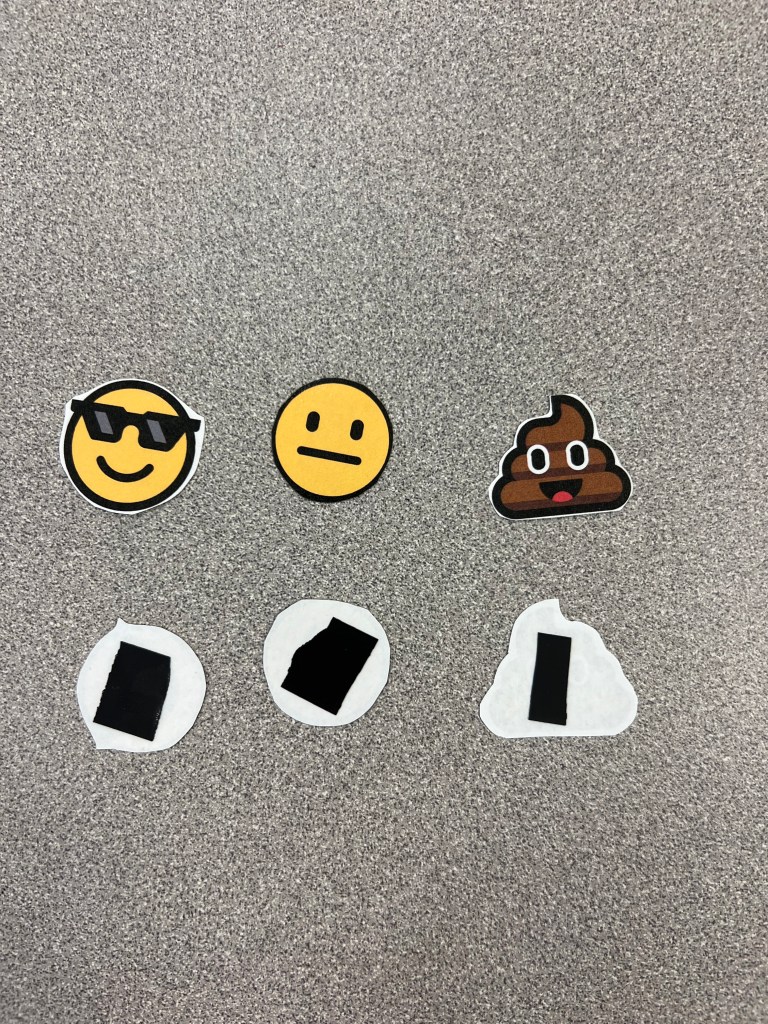
  1. Open a Google Doc, select a 75-point or larger font, and type enough sunglasses emojis to fill a page. (To save time, fill one line and then copy and paste as many times as necessary.)
  2. Repeat with the “meh” and poop emojis.
  3. Print two single-sided copies of the document, laminate it, and cut out the emojis.
  4. Stick a piece of magnetic tape on the back of each emoji and store them in baggies or small containers.

The next time you have a minute or two left at the end of class, get out your emojis and tell the kids that their exit ticket is to choose the one that best matches their current understanding of the lesson and stick it on the board.

Consultants LOVE this, because it hits six buzzwords at once: It’s an exit ticket that serves as a formative assessment by using metacognition as part of the learning cycle in a way that boosts engagement through relevance. (By “relevance,” I obviously mean “scatological humor,” which is EXTREMELY relevant to kids. They love that 💩.)

Posted in Hands-on activities, Learning styles, Math, Sensory, Student engagement, Tactile

Chapter 74: Jellybean Ratios

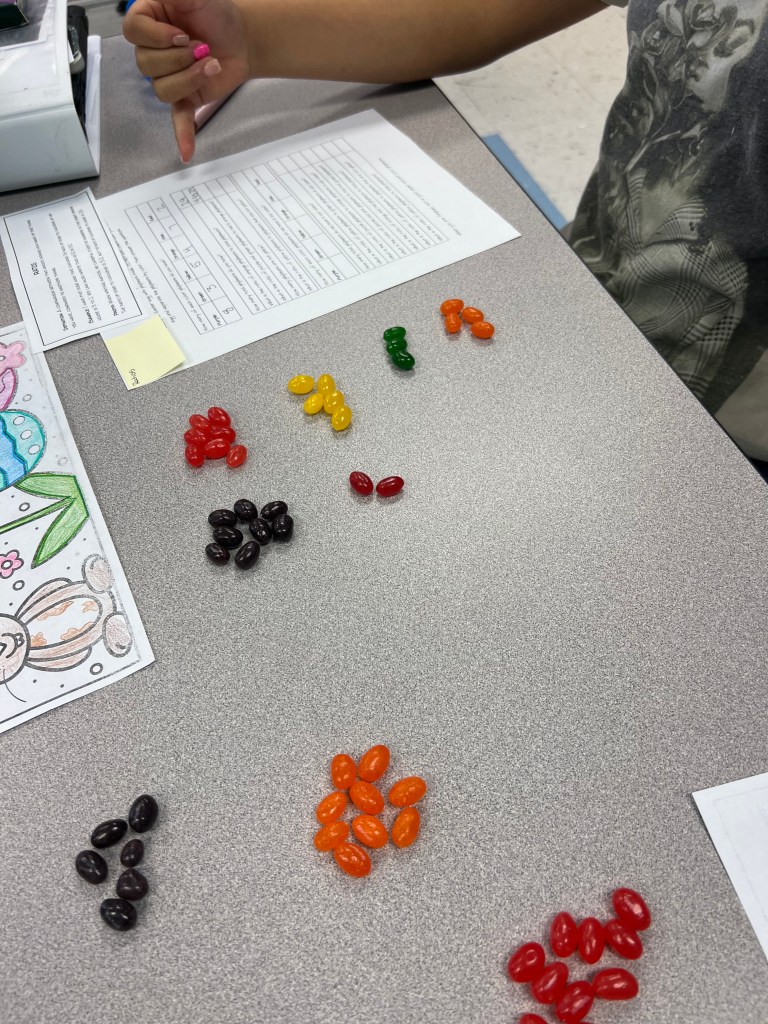
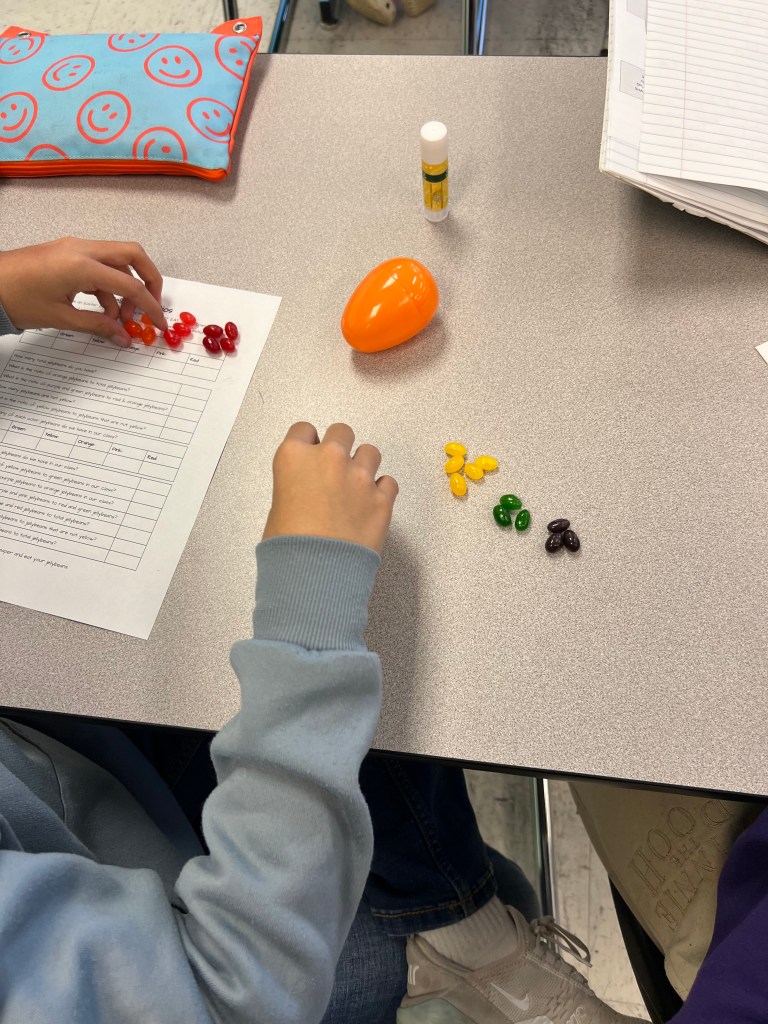
Some of my students are starting a unit on ratios, so I gave them a sweet lesson: I brought in plastic Easter eggs full of jellybeans and instructed them to sort the jellybeans by color, complete a table showing the number of each color they had, and then answer a series of questions:

  • How many total jellybeans do you have?
  • What is the ratio of orange jellybeans to total jellybeans?
  • What is the ratio of purple and green jellybeans to red and orange jellybeans?
  • How many jellybeans are not yellow?
  • What is the ratio of yellow jellybeans to jellybeans that are not yellow?

Once they had their individual jellybeans sorted, I helped them get their class totals, which they entered into a new table, and then they used those numbers to solve a second series of problems:

  • How many total jellybeans do we have in our class?
  • What is the ratio of yellow jellybeans to green jellybeans in our class?
  • What is the ratio of purple jellybeans to orange jellybeans in our class?
  • What is the ratio of purple and pink jellybeans to red and green jellybeans?
  • What is the ratio of orange and red jellybeans to total jellybeans?
  • What is the ratio of yellow jellybeans to jellybeans that are not yellow?
  • What is the ratio of yellow jellybeans to total jellybeans?

Once they completed the assignment, we checked our answers, and then they were allowed to eat their jellybeans.

You can use any type of candy for this activity, as long as it comes in multiple colors and isn’t too messy. I’ve used M&Ms, Starbursts, Skittles, and jellybeans with equal success. Fruit-flavored Tootsie Rolls and Laffy Taffy would also work. I chose jellybeans this time around because A.) I have a student with an allergy that renders M&Ms unsafe, and B.) jellybeans are cheap right now because it’s almost Easter.

Every time I’ve done this activity, I’ve gotten 100% engagement. There’s nothing like the prospect of free candy to get kids invested in a lesson. It’s a very Montessori sort of activity, too, because it involves multiple senses: The kids are looking at the candy, reading and listening to the instructions, discussing their answers, handling the candy as they sort it by color, and (their favorite) tasting and smelling the candy when they get to eat it at the end of the lesson.

Posted in Classroom environment

Chapter 73: Bubble Wrap

My classroom has big windows that let in a lot of light, which is awesome. They’re north-facing, so the room doesn’t get too hot, but there’s enough light coming in to keep a few pothos, spider plants, and sansevierias happy.

That’s great when the weather is warm, but my desk is right next to a window, and it got COLD this winter. I got tired of shivering and decided the district’s business manager was probably tired of paying a fortune for heating bills, so I got on Amazon and ordered a big roll of bubble wrap.

Bubble wrap makes fantastic window insulation, and it’s extremely easy to install: Cut sheets of wrap to fit the window, spray the glass with plain old water (I used a plant mister for this, but a spray bottle works just as well), and stick the bubble wrap on. The water creates a suction-cup effect between the glass window and the plastic.

You’ll have to reapply water here and there as it dries, because the bubble wrap will start to come loose, but the time investment on that is minimal — maybe two minutes a week, including the time it takes to refill the mister, and my kids usually notice the plastic loosening up and tell me about it before I even notice. It looks a little odd up close, but from a distance, it just looks like frosted glass.

Bonus: Bubble wrap is translucent, so your room will still get plenty of light, but it’s not transparent, so the kids can’t see through it easily. That’s a big help in my classroom, which faces the street in front of the building. Before I put up the plastic, my nosy middle schoolers were constantly looking out the window and getting distracted by whatever was happening outside. With the plastic up, they can still see shapes moving past, but it’s cut down on a lot of the distractions.

I gave about $16 for a 100-foot roll of bubble wrap on Amazon and spent maybe half an hour installing it. I’m pretty happy with the ROI; anything that can lower energy costs and raise test scores at the same time is worth $16 and 30 minutes to me.

Posted in Influences

Chapter 72: The Grey Havens

Well, here at last, dear friends, on the shores of the Sea comes the end of our fellowship in Middle-earth. Go in peace! I will not say: do not weep; for not all tears are an evil.”

— J.R.R. Tolkien

I got word today that my fifth-grade teacher, Edd Little, passed away last week. Mr. Little was a spectacular teacher of the sort I aspire to be. He was probably best known for his love of science: Mr. Little’s students dissected earthworms; inspected compost piles; processed black-and-white film in the darkroom he’d set up in his classroom; wandered through the woods in search of ferns to put in pickle-jar terrariums; cracked walnuts; made compasses from a magnetized needle, a cork, and a dish of water; peered at lake water under microscopes; and participated in a hilarious prank he set up to demonstrate the concept of osmosis. We also played Oregon Trail and Mastertype on the Apple IIe next to his desk, wore paper Houghton-Mifflin “Thinking Caps,” watched a documentary about the making of “We Are the World,” assembled tiny paper models of colonial villages, and listened to an eccentric but entertaining guest speaker extol the virtues of running a pick along a small model of a picket fence and counting the clicks to improve our math skills.

Mr. Little didn’t mind differentiating instruction for gifted kids, and he seemed to enjoy challenging me. In his class, I read The Hobbit (which I was kind of excited about, because my dad loved J.R.R. Tolkien’s work) and the entire Lord of the Rings trilogy (which I was less excited about, because I didn’t enjoy The Hobbit as much as I’d hoped and didn’t want to read another 1,500 pages about Middle-earth). I balked and cried and whined and pleaded and grumbled until Mr. Little assured me that if I kept it up, he would add the notoriously dull Silmarillion to my reading list, and Mom assured me that if I made anything lower than a B on my Tolkien test, she would give some other kid the old beach cruiser she was restoring for my birthday. Seventeen hundred pages later, I made an A on my test and swore I’d never read another fantasy novel. I’m sorry I never got a chance to tell Mr. Little about this Harry Potter-inspired blog, or the Hobbit-hole I painted on one wall of my old classroom, or the YA fantasy novel I wrote for my master’s thesis. I imagine he would have laughed his arse off.

Given his wizardry with a lesson plan, I could almost believe Mr. Little was one of the Istari.

Posted in Differentiated instruction, Hands-on activities, Kinesthetic, Learning styles, Math, Student engagement

Chapter 71: Batter Up!

My seventh-graders did another baseball-themed lesson today. This one was really fun: We went to the gym and took batting practice with a wiffle ball and bat. The rules were a variant on the coach-pitch munchkin league softball my little sister played in the late ’80s and early ’90s: I gave every batter seven pitches, and each pitch had three possible outcomes — strike, foul, or hit. Any contact that wasn’t foul was recorded as a hit, and any pitch that didn’t result in contact was recorded as a strike, regardless of how good or bad a pitch it was.

Each student took a turn batting while the rest of the class recorded the outcome of each pitch on a chart that included columns for the batter’s name, each of the seven pitches, the batter’s total hits, and the batter’s contact rate. After we got through the lineup, we returned to class and got out our calculators. The kids counted the hits for each batter, then divided the hits by seven (the total number of pitches) to get a makeshift batting average. Once they had calculated all of the numbers for all of the batters, they used them to calculate the class average.

This was one of those days when I ended up with 100% engagement, and the kids were spectacularly cooperative: silent in the hall on the way to and from the gym, efficient when they reached the gym — no dawdling or horsing around between batters, and I had a couple of ballplayers chasing down balls for me so I wouldn’t have any long delays between pitches — and completely invested in the math when we returned to my classroom. I was especially pleased when I noticed several of the kids helping their classmates by filling in their stats when they were batting. This was completely voluntary — they just started doing it on their own — and wound up being a great timesaver because the batters didn’t have to stop and copy down their own stats after each at-bat.

I love it when my instincts are right, and a lesson that sounds great on paper lives up to its potential.

Posted in Hands-on activities, Math, Student engagement

Chapter 70: Sabermetrics

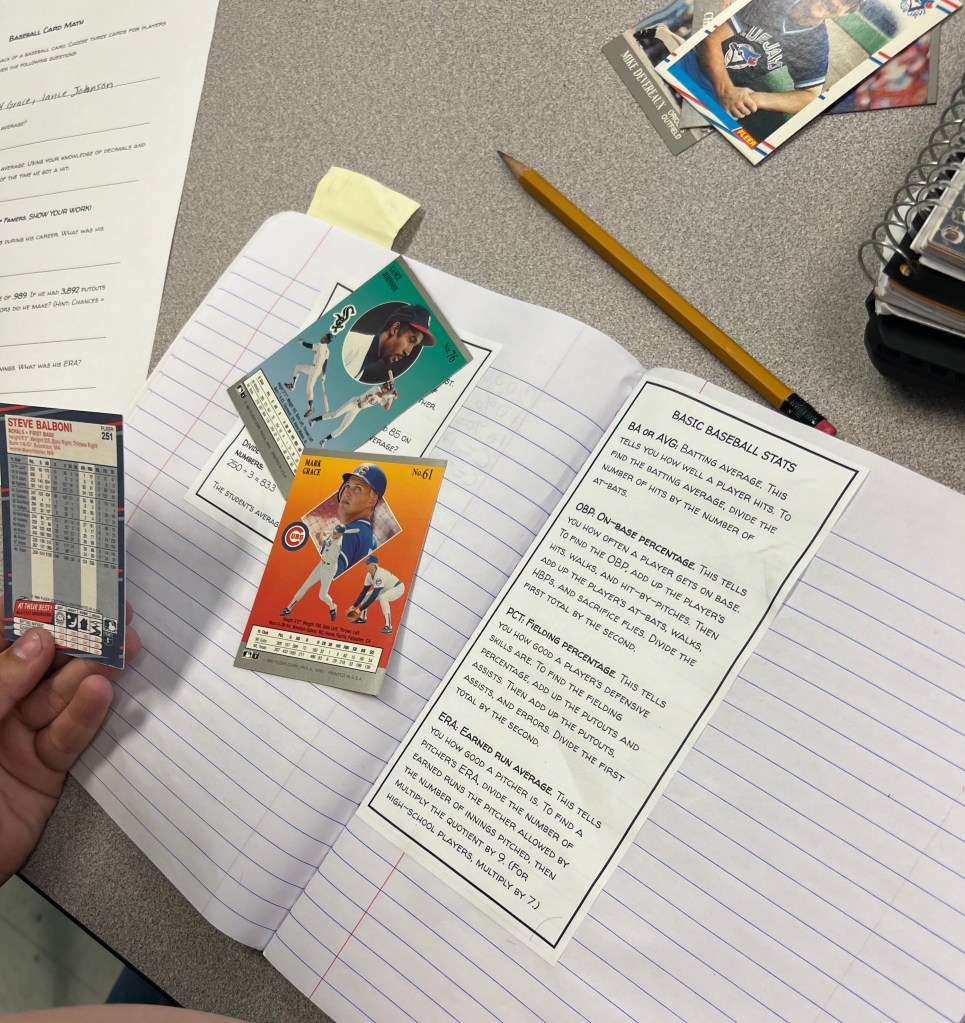
It had been YEARS since I had an excuse to break out a pack of baseball cards in class, but this week, we had a rudimentary lesson on sabermetrics (the study of baseball statistics) to reinforce what my seventh-graders have been learning about ratios, percentages, and averages.

For the first lesson, I did a quick overview of three relatively simple stats: batting average, fielding percentage, and ERA. Each of these stats is pretty easy to understand and to calculate.

I made a cheat sheet with the definition and formula for each stat, plus OBP (which we didn’t end up using for this lesson but might play with later), and had the kids paste it into their notebooks so they’d have everything they needed to work with the numbers.

I used to have a pretty respectable baseball card collection, but I gave it to my softball-obsessed goddaughter and her older sister about 10 years ago, when I didn’t think I’d be teaching math again, so my first order of business was to scrounge up some cards. I found a bundle of seven old ’80s and ’90s wax packs on Amazon for $11.50 and let the first group of students have the fun of opening the packs to see what was inside (with a careful admonition not to chew any gum they found inside, as it was likely to be older than their parents).

I put the kids in groups of two or three and gave each group a wax pack and a handout containing the following text:

Baseball Card Math

There’s a lot of math on the back of a baseball card. Choose three cards for players who are not pitchers and answer the following questions:

1. Who are your three players?
2. Which player has the best batting average?
3. Choose one player. Look at his batting average. Using your knowledge of decimals and percentages, determine what percentage of the time he got a hit.
Now, let’s look at some of my favorite Hall of Famers. SHOW YOUR WORK!
4. Ted Williams had 2,654 hits in 7,706 at-bats during his career. What was his lifetime batting average?
5. Ryne Sandberg has a lifetime fielding percentage of .989. If he had 3,892 putouts and 6,648 assists in 10,660 chances, how many errors did he make? (Hint: Chances = putouts + assists + errors.)
6. Mariano Rivera allowed 315 earned runs in 1,283.2 innings. What was his ERA?

Question 2 seemed easy enough, but I quickly realized that most of the kids had no idea how to find information on the back of a baseball card, so we had to do a quick mini-lesson on that. (Fleer’s weird habit of using “PCT” to mean batting average instead of fielding percentage didn’t help.) Question 3 tied into our recent study of percentages, while Question 4 helped build their confidence. Question 5 was a bit of red herring, because the kids’ cheat sheets contained the formula for calculating fielding percentage, but the question itself really only required them to find the difference between Sandberg’s chances and his successful plays. The math is easy, but they had to slow down and think about the question, which is challenging for them. Meanwhile, Question 6 was easy for the kids who referred to their notes, but those who tried to work from memory got it wrong because they forgot to multiply the ratio of ER to IP by 9 to get the answer.

Assuming the kids cooperate, tomorrow’s lesson — which is based on one I did about 12 years ago in Tulsa — should be even more fun. If it goes smoothly, I’ll share it.

Posted in Advice for rookies, Classroom management, Discipline

Chapter 69: Notes

One of my favorite behavior management strategies is to send out handwritten notes on pretty cards with no return address. Most of the time, the notes are good news: I write to parents when their kids have improved their grades, worked hard on a project, been unusually kind to a classmate, etc.

Every now and then, the notes are less pleasant. If I have warned a kid to settle down in class multiple times, with no sign of improvement, I’ll send a little message to the child’s parents, letting them know that we have an ongoing behavior issue that needs to be addressed at home.

Here are the keys that make this system so effective:

  1. I send out far more positive notes than negative. Within the first month of school, I try to send every child’s family a note praising something about the child. This gets the parent on my side and makes it far more difficult for a kid to pull the “my teacher is just picking on me because she hates me” card if I have to send out a critical note later.
  2. Even my critical notes have an upbeat tone. Whenever I send a note asking a parent to help address a behavior issue, I praise the child’s good qualities, express concern for the child’s future, and spin the misbehavior into a potential asset (e.g., incessantly cutting up in class = wonderful sense of humor). Most people aren’t going to get defensive if a teacher says, “I care about your kid and want him to be successful, which is why I’m asking you to help me channel his gifts in a more productive direction.”
  3. I make the notes virtually impossible to intercept. They come without warning, on cute stationery, with no return address. They are always handwritten, but I always switch up the lettering style on the envelopes; the colors of the envelopes; and the ZIP codes from which I send the notes. It’s hard to intercept a letter if you don’t know it’s coming and can’t tell it’s a note from your teacher because it looks like a random greeting card. (My favorite was a fun little Halloween card I picked up at Walmart one night and sent to a guardian whose grandsons were failing English because they refused to do any work. She found the incongruity between the card and its contents absolutely hilarious and happily agreed to send the boys to my next after-school makeup work session so they could get caught up.)

The snitch notes are useful, but the real power lies in the positive notes. I’ve had parents call me to tell me that I’m the only teacher who has ever reached out to them to tell them something good about their child. I’ve had kids message me on social media several years after graduation to share pictures of the notes I sent to their parents, which have turned into cherished keepsakes. And I’ve seen notorious troublemakers straighten up and apply themselves in my class once they realized I cared enough to make them look good to their parents.

I really need to spend more time writing notes to parents. The payoff is always worth the investment of time.

Posted in Collaborative learning, Competition, Math, Student engagement, Success

Chapter 68: Road Trip!

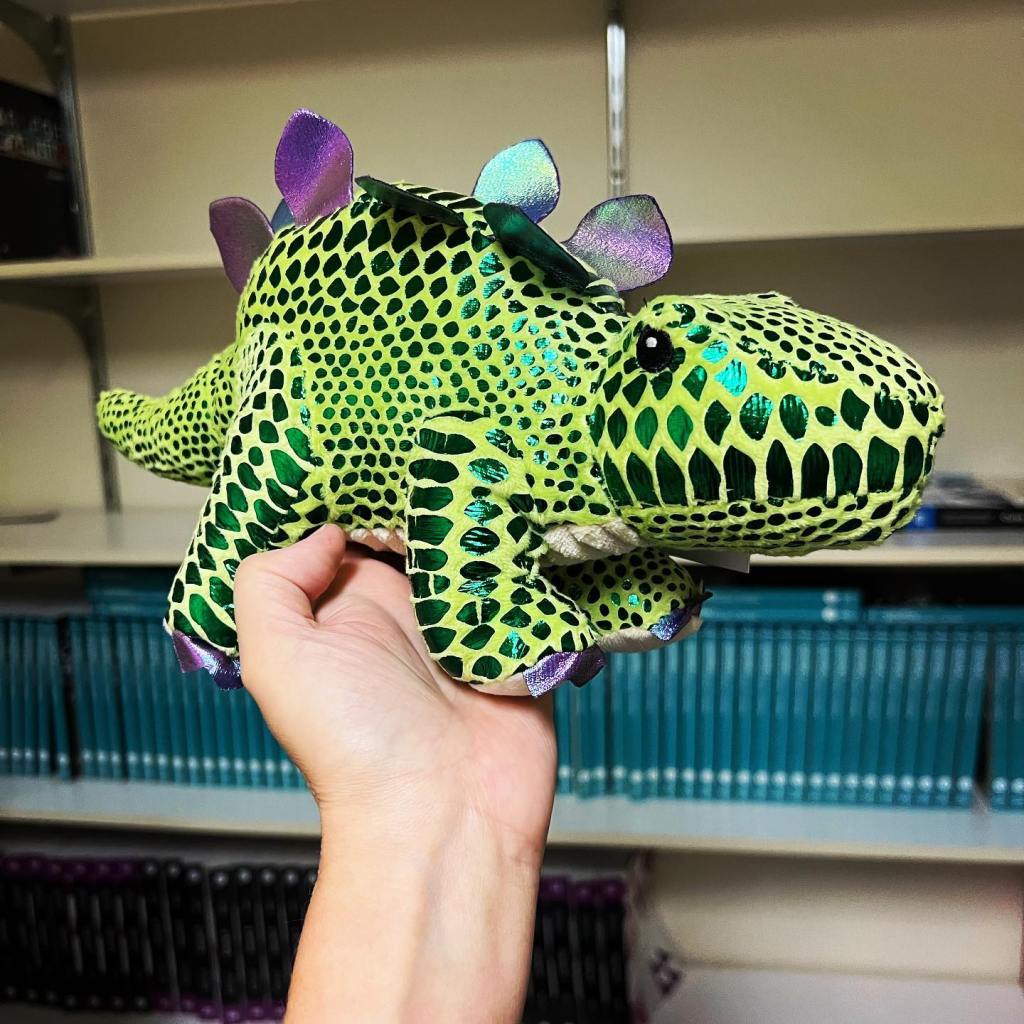
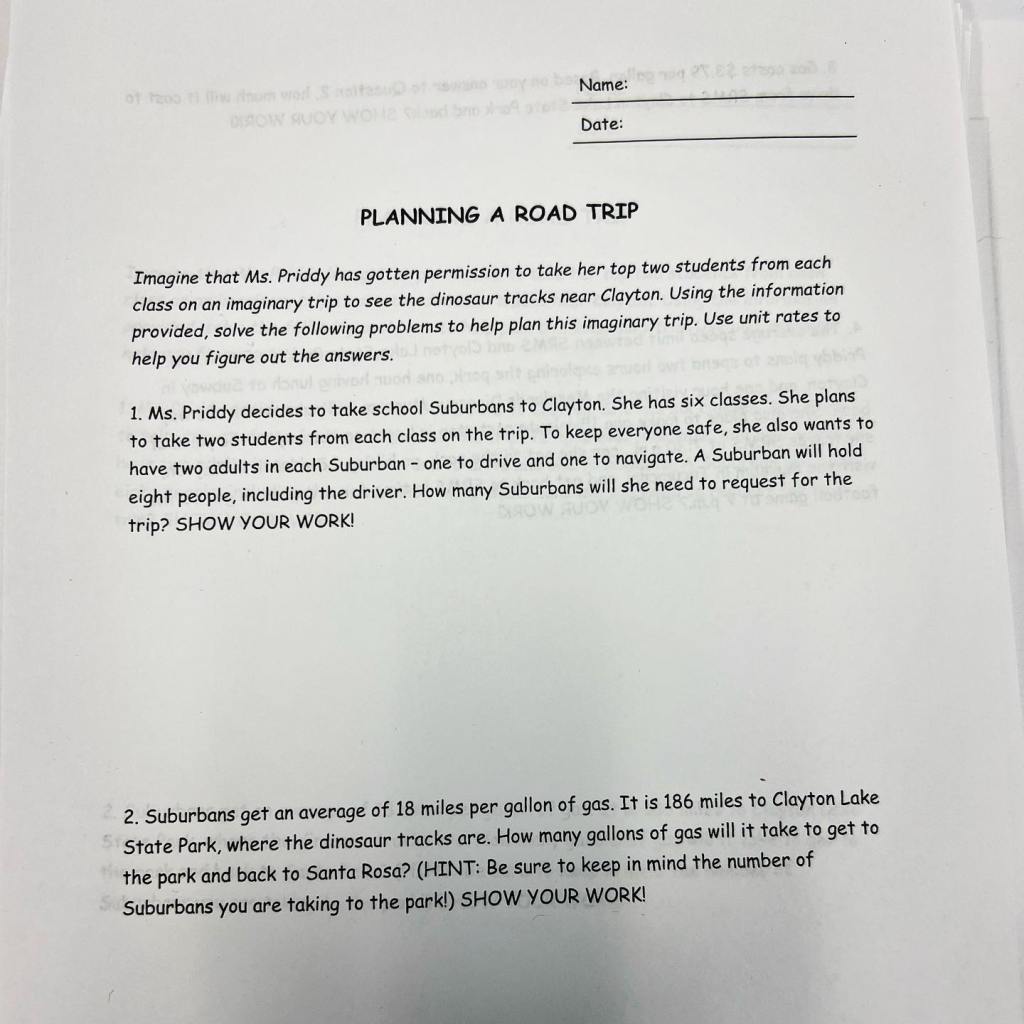
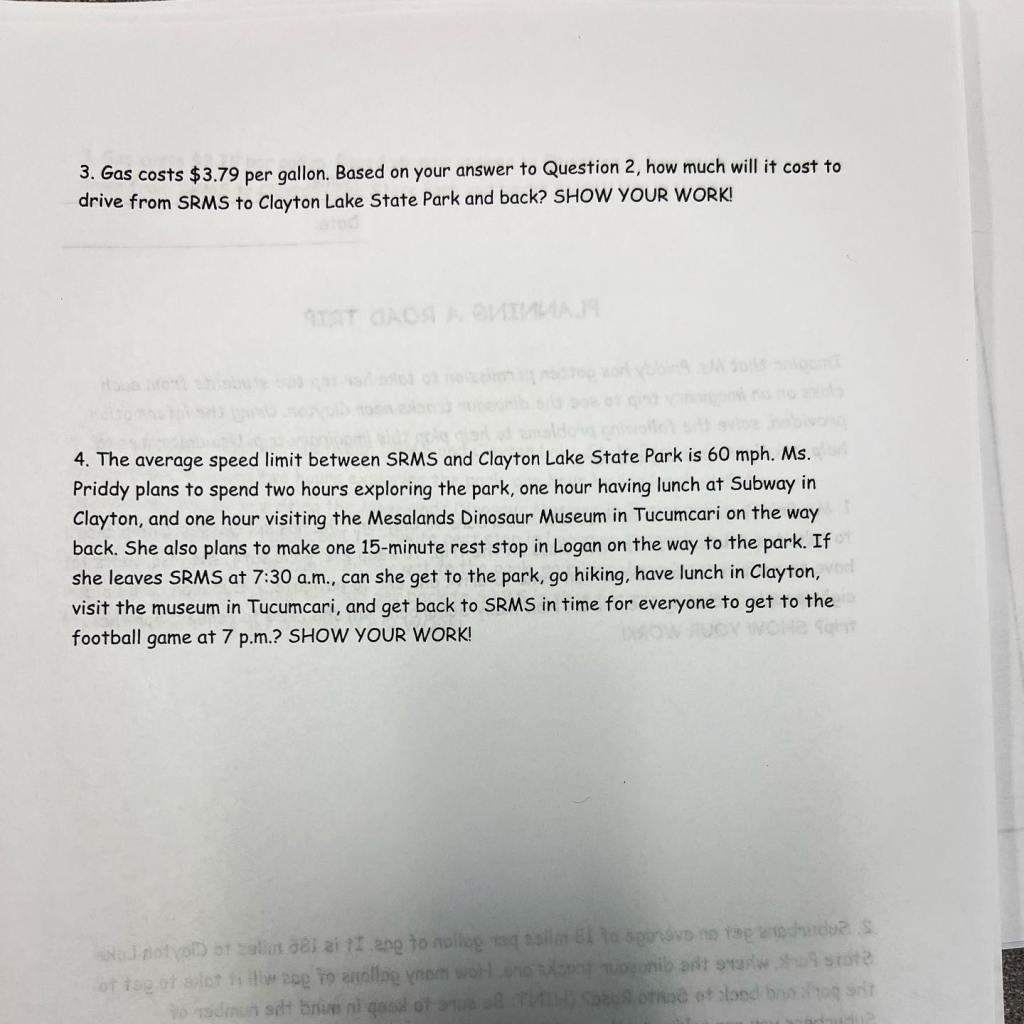
Kids sometimes have trouble understanding why they need to learn math, especially if it’s challenging, so I spend a lot of time looking for ways to make it relevant to their interests. To that end, I like to incorporate an imaginary road trip into their study of unit rates. This particular group struggles with motivation, so I planned an imaginary trip to Clayton Lake to see the dinosaur tracks and asked them a series of four questions about gas mileage, expenses, speed, and itinerary. They worked in small groups to answer the questions, and the first team to answer all four questions correctly earned dinosaur plushies.

My kids love dinosaurs, competition, working in groups, and getting stuff for free, so a team competition with free dinosaurs on the line yielded 100% engagement. Better still, the kids saw the practical application for the math they were learning, which means they’ll be more likely to remember it and use it later.

Below are the questions we used. If you do something similar in your classroom, you’ll obviously want to choose a location in your area and use Google to get the distances, prices, etc., but this gives you a rough idea of how I put this together.

You can get more elaborate if you want. Last year, when my sixth-graders were learning ratios, I put together a multi-day unit that involved planning every detail of an imaginary trip from House, New Mexico, to Holbrook, Arizona, to go hiking in the Painted Desert. We figured up mileage, meal costs (including tip and tax), gas prices, lodging, travel time, bottled water usage, and I don’t remember what all else. It was a long unit, but the kids really got into it — especially after the owner of our chosen lodging establishment, the Wigwam Motel, was kind enough to send them some key tags and postcards to keep as souvenirs of their imaginary trip.

I didn’t have as much time available this year, so I kept our trip short and simple, but the kids still had a good time. If you’re looking for a way to make unit rates understandable, I can highly recommend this approach.

Emily

Posted in ELA, Math, Teachable moments

Chapter 67: A Rant

New Mexico’s Public Education Department is trying to force schools to increase our number of instructional days by about 20% next year unless we manage to improve our ELA test scores by 8% to 15% overnight.

This would be a reasonable demand if not for the fact that A.) PED told some schools last year that a 5% improvement was an unrealistic goal, B.) the schools operating on four-day schedules generally perform better than the schools operating on the five-day schedule favored by PED, and C.) this policy basically forces teachers to commit to another year in our districts before we how many days we’ll be required to work, which I am pretty sure isn’t actually legal.

Politicians and bureaucrats would rather chew off their own legs than involve an actual teacher in any decision that affects schools, but if they asked me, I could tell them why ELA scores are low:

  1. The questions are poorly written. I have a master’s degree in English and can’t figure out the answers to some of the released items from the state ELA tests, because they’re so convoluted and ambiguous that they sound like what you’d get if James Joyce wrote a parody of the SAT while high on psychedelic mushrooms.
  2. The tests are poorly timed. Every year, PED tells us to give our end-of-year tests six weeks before the end of school, and every year, PED is disappointed that the kids haven’t mastered all the material.
  3. COVID. Specifically, the cognitive and emotional impact of trauma, economic marginalization, and long COVID, all of which affect test scores far more than the loss of instructional quality and quantity caused by the shutdowns in 2020 and 2021.

If PED were serious about improving test scores, they would:

  • Hire a team of journalists to edit the tests for clarity. This would boost scores instantly, because kids would understand what the questions were asking.
  • Streamline standardized testing. We lose nearly four weeks of instructional time to standardized tests every year: a week each for BOY and MOY benchmarks, and up to two weeks for the EOY. Worse, the aforementioned timing issue leaves a lot of kids (and probably a few teachers) with the impression that whatever happens after mid-April isn’t really important — so we basically lose another six weeks to post-assessment apathy. This is both inexcusable and entirely avoidable.
  • Reduce middle-of-the-year disruptions. Every teacher knows that students’ behavior and ability to focus deteriorate as their excitement about an upcoming break increases. They’re at school, but they’re not learning much. We could reclaim some of that lost time by dumping Monday holidays, inservice days, etc. and tacking those days onto our existing longer breaks. (And if we want to honor historical figures, we can study them on their special days.)

By my calculations, implementing my ideas would reclaim between 32 and 37 days’ worth of lost or compromised instructional time — significantly more than the 25 days PED is trying to add to the calendar.

Most problems have relatively simple solutions, but it’s hard to see them when you refuse to listen to actual stakeholders.

Emily